
- Author
- Date
- 2026-02-20
- Views
- 440
Winter skin concerns are not simply because of cold temperatures.
What actually breaks down the skin faster is indoor heating.
When the heater is operated in a space where you spend most of the day, indoor humidity drops sharply, and the skin is exposed to constant dehydration pressure.
The skin dryness that begins at this time is not just a seasonal symptom. If dry skin persists, the moisture density of the stratum corneum collapses, and the skin barrier function deteriorates. Furthermore, skin breakouts easily occur even with small irritations.
The core of winter skin management is not 'applying more,' but understanding what structural changes the heating environment creates in the skin.
Table of Contents
Trend 1. The Secret of ‘Accelerated Moisture Evaporation’ Created by Winter Heating
Trend 2. Step-by-Step Progression of Barrier Lipid Collapse and Sensitization
Trend 3. Multi-Layered Design Strategy of Ultra-Moisturizing, Occlusive, and Lasting Hydration
Trend 4. Excessive Management and Adverse Effects to Avoid in Dry Environments
Trend 1. The Secret of ‘Accelerated Moisture Evaporation’ Created by Winter Heating
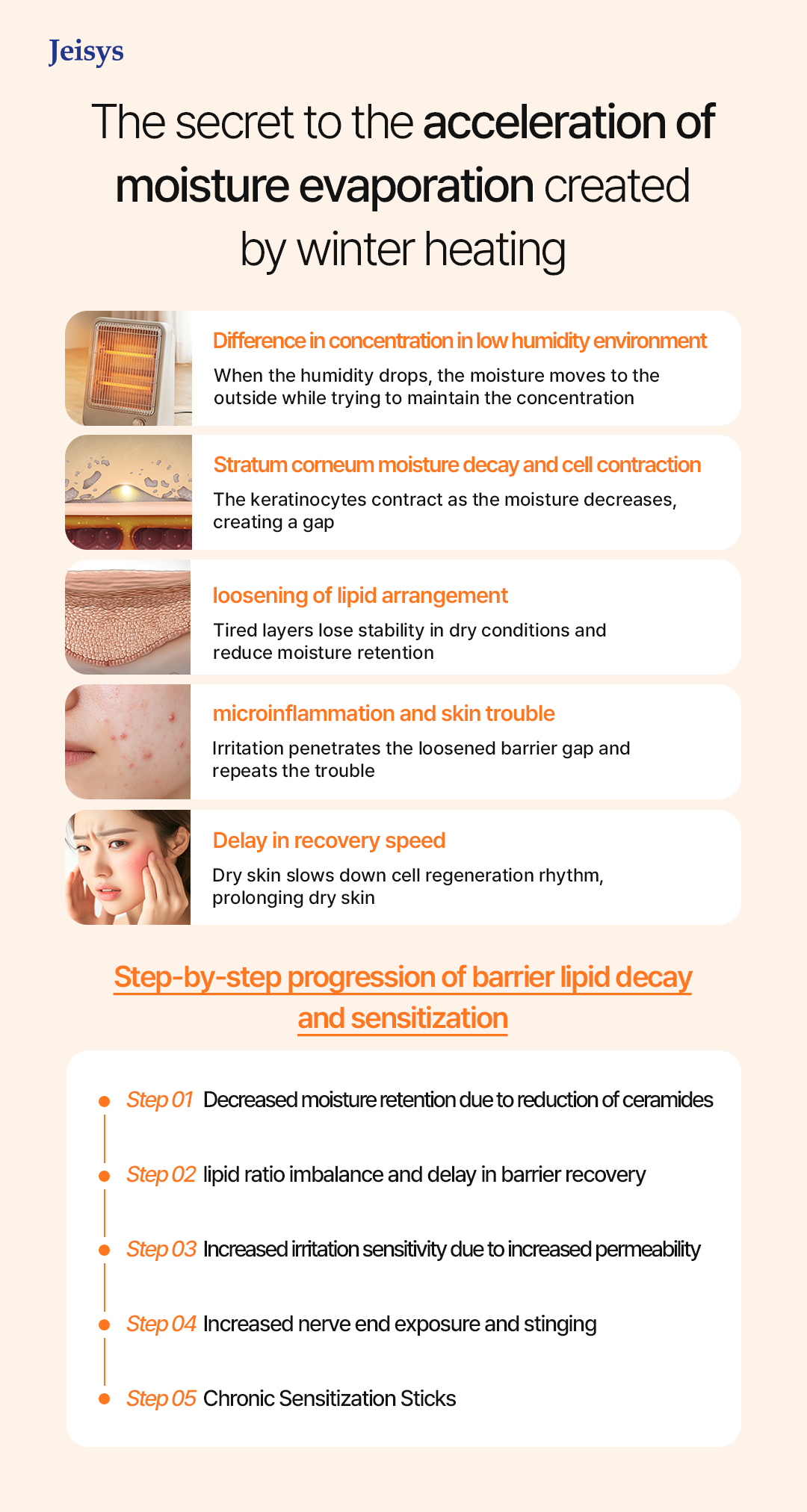
The skin always releases a certain amount of moisture to the outside. This is called Transepidermal Water Loss (TEWL). In a normal environment, this figure is balanced, but when heating is turned on, the situation changes. As the humidity in the air decreases, the difference in moisture concentration between the inside and outside of the skin increases, and the speed of moisture movement accelerates rapidly. As a result, skin dryness intensifies in a short period of time.
① Expansion of Concentration Difference in Low-Humidity Environments
When humidity drops to the 20% range due to heating, moisture inside the skin moves quickly to the outside while trying to maintain a relatively high concentration. At this time, dry skin feels a rapid tightening sensation and surface roughness increases.
② Collapse of Stratum Corneum Moisture and Cell Contraction
When moisture decreases, keratinocytes contract and create gaps. These gaps are not just simple flaking of dead skin cells, but a signal of weakened skin barrier density.
③ Loosening of Lipid Arrangement
The lipid layer, composed of ceramides, cholesterol, and fatty acids, loses stability in a dry state, leading to a decrease in moisture-holding capacity.
④ Occurrence of Micro-Inflammation and Skin Breakouts
As external irritants penetrate through the loosened gaps in the barrier, redness, stinging, and small skin breakouts are repeated.
⑤ Delay in Recovery Speed
Continuous skin dryness slows down the cell regeneration rhythm, creating an environment where dry skin becomes prolonged. In short, heating is an environmental variable that provides warmth while simultaneously accelerating the loss of moisture.
Trend 2. Step-by-Step Progression of Barrier Lipid Collapse and Sensitization
The skin barrier is a defense system where keratinocytes and lipids are elaborately arranged. When the dry skin condition exceeds a certain level, this balance begins to collapse.
① Decrease in Moisture-Fixing Power Due to Reduced Ceramides
Ceramides are core ingredients that hold moisture. If skin dryness is repeated, the ceramide content decreases, and the moisture evaporation rate becomes even faster.
② Lipid Ratio Imbalance and Delay in Barrier Recovery
When the ratio of cholesterol and fatty acids is broken, the recovery speed of the skin barrier slows down, and dry skin does not recover easily.
③ Increased Sensitivity to Irritation Due to Increased Permeability
When the barrier becomes loose, the penetration rate of external pollutants and irritating ingredients increases, raising the possibility of skin breakouts.
④ Exposure of Nerve Endings and Increased Stinging
Skin dryness lowers the nerve response threshold, causing sensitive reactions even to small temperature changes.
⑤ Fixation of Chronic Sensitization
If this state persists, the deterioration of the skin barrier function becomes permanent, and skin breakouts are repeated. Ultimately, dry skin is not just a simple lack of moisture, but a weakening of structural defense.
Trend 3. Multi-Layered Design Strategy of Ultra-Moisturizing, Occlusive, and Lasting Hydration
In a heating environment, light moisture layering alone is not enough. To stop skin dryness, a step-by-step design is necessary.
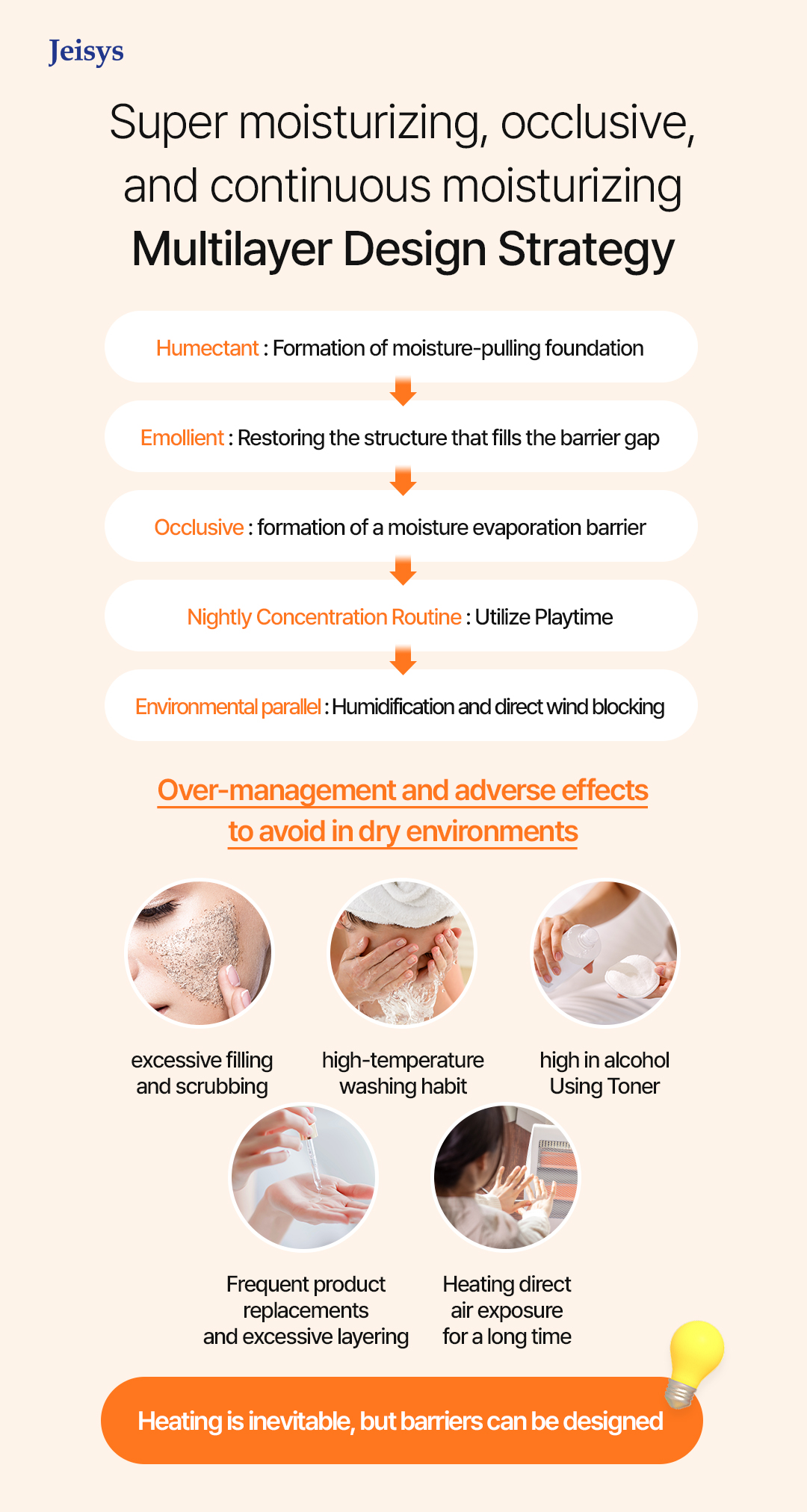
① Humectant Stage – Forming a Foundation to Pull in Moisture
Hyaluronic acid and glycerin are representative humectants that pull in moisture present in the air or deep layers of the skin to temporarily swell the stratum corneum. Simply put, they play the role of 'calling together' moisture on the skin surface. This is effective in alleviating initial skin dryness and helps to quickly reduce the tightening sensation. However, if used alone in a low-humidity environment like heating, there may be a lack of moisture to draw from the outside, potentially leading to moisture being taken away from inside the skin. Therefore, in a dry skin state, it is important to carry this out in conjunction with the next stage.
② Emollient Stage – Structural Restoration to Fill Gaps in the Barrier
Ceramides, fatty acids, and squalane are representative emollients. They fill the gaps between keratinocytes and smooth the surface to increase skin barrier density. This is not just about making it look moist; it is a process of stabilizing the lipid structure to reduce the pathways through which moisture escapes. Especially in dry skin, the emollient stage is a core step for rearranging the barrier and plays an important role in preventing repeated skin dryness and skin breakouts.
③ Occlusive Stage – Forming a Moisture Evaporation Barrier
Occlusive literally means 'to cover and block.' Vaseline, shea butter, and mineral oil fall into this category, forming a thin protective film on the skin surface to reduce TEWL. It is easy to understand it as putting a 'lid' on to prevent the already filled moisture from escaping. Particularly in situations where moisture evaporation is fast, such as in heating environments, the occlusive stage becomes a decisive strategy to prevent the worsening of dry skin.
④ Nighttime Intensive Routine – Utilizing Regeneration Time
Skin regeneration activity is active during the night. Using high-moisturizing creams or sleeping packs at this time can increase the recovery speed of the skin barrier.
⑤ Concurrent Environmental Management – Humidification and Blocking Direct Wind
Maintaining indoor humidity at 40-60% using a humidifier can alleviate the speed of skin dryness. Avoiding direct wind from the heater alone can lower the risk of skin breakouts. This multi-layered strategy is a structure that simultaneously achieves skin barrier recovery and prevention of skin breakouts.
Trend 4. Excessive Management and Adverse Effects to Avoid in Dry Environments
In winter, there is a tendency to try to manage dry skin 'more.' However, excessive care actually induces skin breakouts.
• Excessive Use of Peeling and Scrubs: This further damages the already weakened skin barrier, deepening skin dryness.
• High-Temperature Cleansing Habits: Hot water melts lipids, lowering barrier density and worsening dry skin conditions.
• Misuse of Toners with High Alcohol Content: Behind the momentary refreshing feeling, it accelerates moisture evaporation, increasing the risk of skin breakouts.
• Frequent Product Changes and Excessive Layering: When various ingredients overlap, residues that are not absorbed can cause irritation.
• Long-Term Exposure to Direct Heater Wind: Direct heat irritation rapidly worsens skin dryness and delays barrier restoration.
In winter, 'stabilization care' is needed rather than 'strong care.'
Heating is Unavoidable, but the Barrier can be Designed
Winter skin dryness is an environmental variable. However, dry skin does not necessarily lead to skin breakouts. The key lies in how stably you maintain the skin barrier. A multi-layered strategy of filling moisture, restoring lipids, and blocking evaporation. If you cannot turn off the heating, you must strengthen the barrier. A skin barrier that does not waver even in the heater wind. This winter's answer to skincare lies not in sensation, but in structural moisturizing design.

