
- Author
- Date
- 2026-02-13
- Views
- 67
Skincare routines that are all the rage on SNS, routines praised by acquaintances—looking at the reviews alone makes you think, "This is a must." However, when you actually try it yourself, there are times when you feel there is less change than expected, or it seems okay at first but quickly returns to its original state, or even causes skin breakouts.
So, thoughts like "Is my skin strange?" "Why doesn't it fit only me?" or "Is skincare just not meant for me..." might come to mind. However, there is a fact you must point out here.
The effectiveness of skincare starts not from a 'difference in skill,' but from a 'difference in skin structure.' Skincare is an area where individual differences are much larger than you might think. Even if it looks similar on the surface, the reaction speed, skin regeneration rhythm, recovery method, and staying power are completely different for everyone.
Table of Contents
Trend 1. Skin has a Different ‘Reaction Speed’ to Begin With
Trend 2. Skin is Designed with Different ‘Resilience’
Trend 3. The Difference in ‘Staying Power’ Creates the Difference in Results
Trend 1. Skin has a Different ‘Reaction Speed’ to Begin With
— Why the Timing of Results Varies Despite the Same Treatment
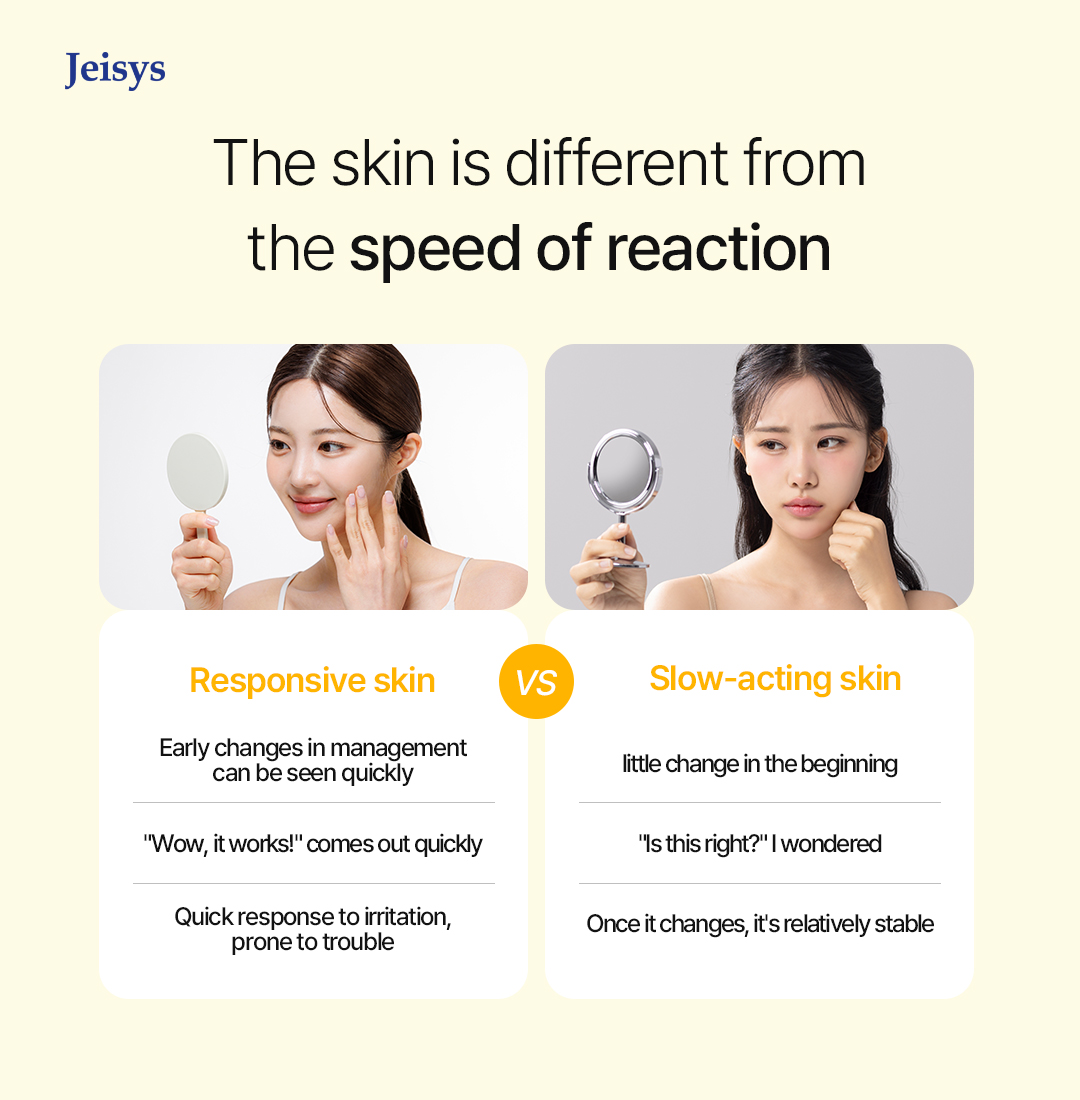
The first thing to understand is that skin starts from a different starting line. Usually, the skin turnover cycle is known to be 28 days, but this is truly just an 'average value.' In reality, there are skins with fast turnover around 20 days and slow skins that take more than 40 days. What does this difference create?
✔ Fast-reacting Skin
- Changes are visible early in the skincare process
- "Wow, it works!" is said quickly
- Instead, it also reacts quickly to irritation, making it prone to skin breakouts
✔ Slow-reacting Skin
- Almost no change in the beginning
- Questions like "Is this right?" arise
- However, once it changes, it remains relatively stable
Therefore, even with the same treatment, someone might say their skin changed in 1-2 weeks, while you might feel, "I'm still not sure..." even after a month. This is neither insensitive skin nor problematic skin. Your skin is simply a 'slow-reacting turnover type.'
Trend 2. Skin is Designed with Different ‘Resilience’
— Enduring Skin vs. Recovering Skin
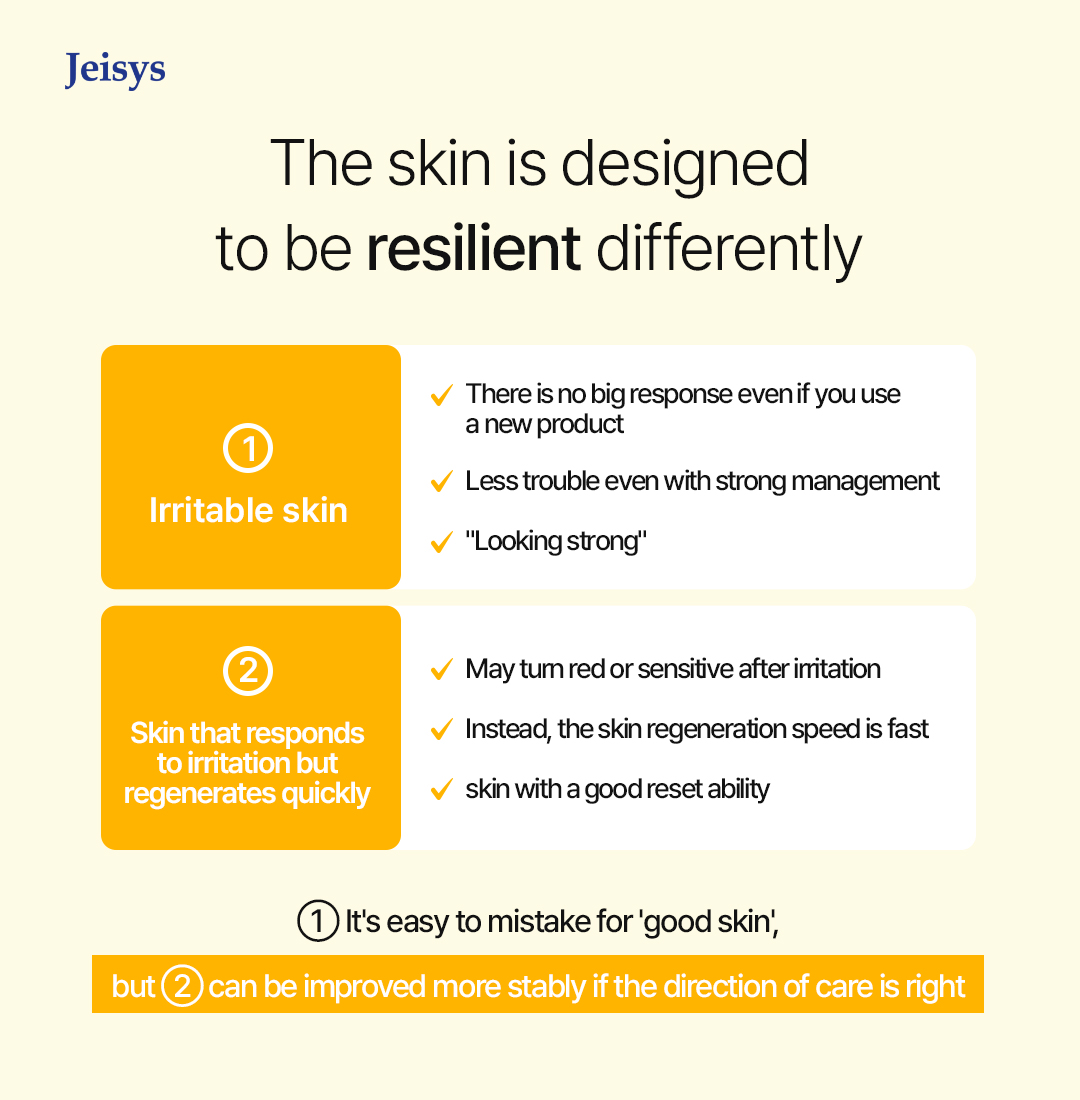
When looking at skin, there are largely two tendencies.
① Skin that tolerates irritation well
- No major reaction even when using new products
- Few breakouts even with strong treatments
- Outwardly looks like "strong-looking skin"
② Skin that reacts to irritation but has fast skin regeneration
- May turn red or become sensitive after irritation
- Instead, the skin regeneration speed is fast
- Skin with good resetting ability
The problem is that we often mistake type ① for 'good skin.' However, type ② skin often moves toward a more stable state if the management direction is correct. Here is one important point: For recovery-type skin, the problem is not 'irritation' itself, but 'having no time to recover.'
So, even if it was a skincare routine that was fine at first, as you continue to receive it, you feel the skin getting tired. Then, at some point, skin breakouts appear, leading to the conclusion, "I don't think this fits me." This is not because the management was wrong, but the result of continuous irritation without a chance for the skin to recover. For this type of skin, when you lower the intensity, widen the intervals, and switch to a skin regeneration-centered routine, you get the feeling, "Oh? It's getting better again."
Trend 3. The Difference in ‘Staying Power’ Creates the Difference in Results
— Why it Improves and Then Quickly Returns to Original State
"It was really good when I got the treatment, but after a few days, it's back to how it was..." This is a very common thing people say. However, this doesn't mean the treatment was ineffective. Rather, it is closer to a signal that staying power was lacking. There are two stages to skin change: the stage of getting better and the stage of maintaining the improved state.
Many skincare treatments (including aesthetic care) and products create the 'getting better' stage well, but they cannot take responsibility for staying power. This is because skin with weak staying power loses moisture easily and is very sensitive to environmental changes (weather, sleep, stress). Furthermore, if the skin condition fluctuates greatly depending on your physical condition and the turnover rhythm is disrupted, it immediately becomes rough, which is truly not easy.
So, even if you feel "Oh, it's okay" right after treatment, it returns again after just a few days. What this skin needs is not stronger management.
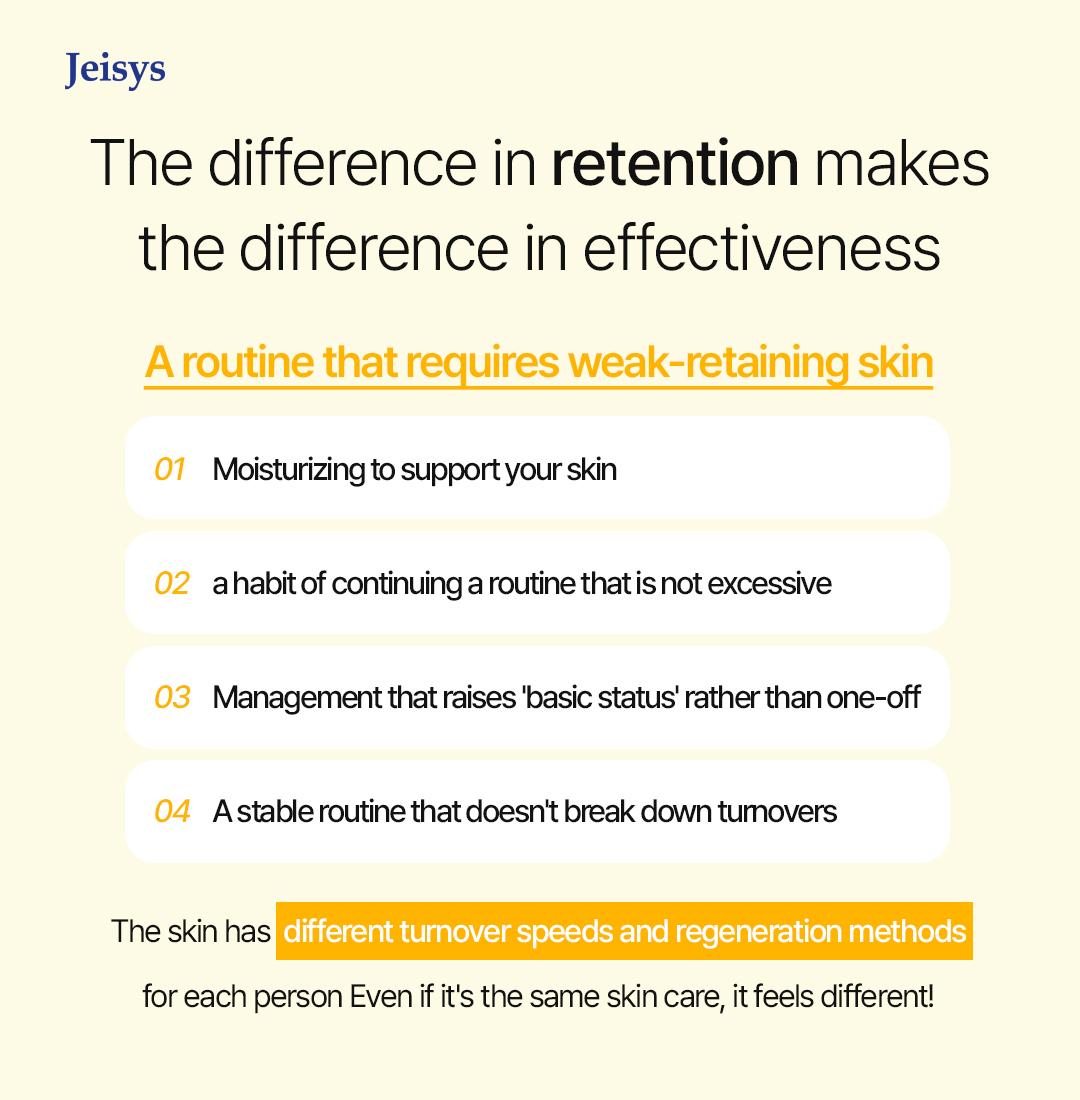
• Moisturizing that supports so it doesn't fluctuate often
• Habits of continuing a routine that isn't excessive
• Management that raises the 'basic state' rather than a one-time fix
• A stable routine that doesn't break the turnover
Rather, when you start establishing a routine like this, you will start saying, "This time is different." When skincare feels like it only doesn't fit you, it's neither a failure nor the fault of your skin. It's because everyone has different turnover speeds and different skin regeneration methods. Because the power to endure irritation is different and the staying power is different, the experience of the same skincare must be different.
Therefore, what's important is, after all, not to judge yourself based on the results of others. Skincare is not a competition, but a process of finding the 'instruction manual that fits my skin perfectly.' It's okay to be a little slow, and it's okay to have skin breakouts in the middle. The moment you understand the speed and rhythm of your skin, management becomes much less anxious and the results last much longer.
Next time you have anxious thoughts, try changing your thinking like this: "There isn't a problem with my skin; it's just that this management isn't my way." This thought alone makes skincare much more comfortable.
- Prev
- 이전글이 없습니다.

