
- Author
- Date
- 2026-01-16
- Views
- 143
You’ve probably had the experience of meticulously applying toner, lotion, and even cream in the morning, only to have your skin start feeling tight again by lunchtime.
Thinking, “Ah, it must be because of skin dryness,” you try spraying a mist, but that’s only temporary. Even if you come home and apply a thick layer again, the same tightness repeats the next day. By this point, you start to have thoughts like: “Is my skin naturally dry?” or “Do I need to change my moisture management products again?”
However, there is a key point you must check here. If your skin keeps pulling despite clearly applying products, there is a high possibility that it is a ‘signal that moisture is not being maintained’ rather than a lack of moisture.
In other words, it could be skin dryness caused not by an inability to put moisture into the skin, but by an inability to hold onto the moisture you’ve put in.
Table of Contents
- Trend 1. The Winter Dry Skin Misconception
- Trend 2. Where does ‘moisture maintenance failure’ begin?
- Trend 3. Core strategies to stop skin tightness
Trend 1. The Winter Dry Skin Misconception
- Why the formula ‘Filling it solves it’ doesn’t work -
For a long time, we have been taught: “If your skin is dry, fill it with moisture.”
So, when winter comes, we focus on moisture management by applying moisture toners, moisture ampoules, and moisture creams in larger amounts and more frequently than usual. But strangely, in winter, no matter how much you apply, the tightness characteristic of dry skin does not easily disappear.
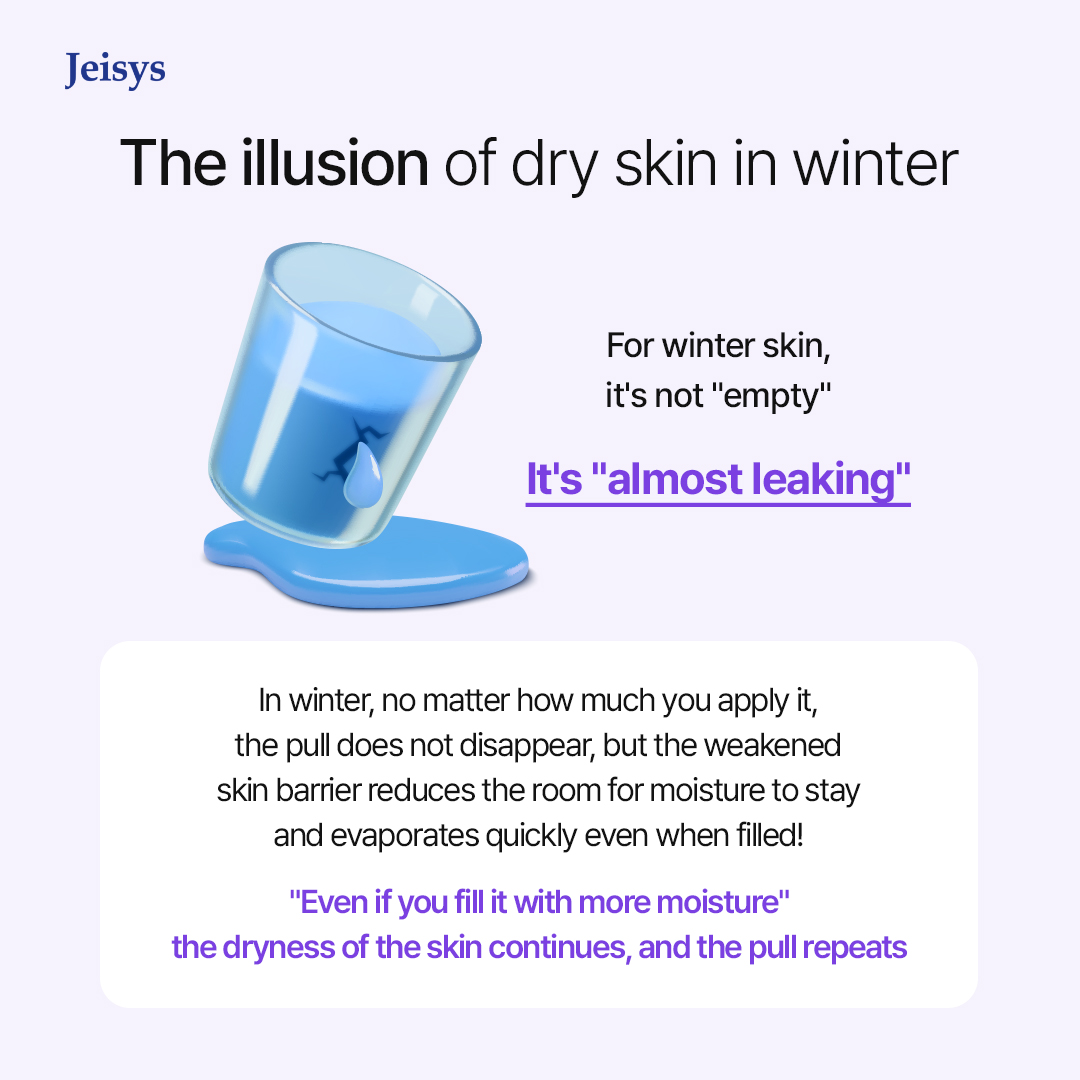
The reason is simpler than you think. This is because winter skin is not in an ‘empty state,’ but in a ‘leaking state.’
Filling a cup with water is a completely different story from filling a cracked cup with water. The same goes for your skin. In winter, the skin barrier weakens, the space for moisture to stay decreases, and the environment becomes one where the moisture you’ve filled evaporates quickly. Therefore, even if you “fill more moisture,” skin dryness continues and the tightness repeats.

Trend 2. Where does ‘moisture maintenance failure’ begin?
- 3 structural reasons why moisture escapes -
Then why is winter skin so unable to hold onto moisture? This issue is not just about a simple lack of moisture, but is related to simultaneous changes occurring throughout the skin structure.
① Gaps in the skin barrier open up
The cold winter air and indoor heating weaken the barrier that acts as a protective shield on the skin surface. When the barrier becomes loose, it’s easy for moisture to enter, but the speed at which it leaves becomes much faster. That’s why even if you work hard on moisture management, the skin soon starts to feel tight again.
② Moisture pressure inside the skin drops
Furthermore, moisture inside the skin is not just an element for hydration; it also plays a role in creating the ‘supporting force’ that holds the skin up from the inside. However, in winter, as this moisture pressure drops, the skin becomes flat from the inside, and as a result, the surface dries out more easily, leading to a dry skin state.
③ Sebum and lipid balance is broken
Many people think it’s good that sebum decreases in winter, but in fact, sebum also acts as a protective film that holds moisture in. Therefore, if sebum decreases too much, the film that catches moisture disappears, and the skin more easily leans toward a state of moisture deficiency.
When these three—the barrier, moisture pressure, and lipid balance—are shaken simultaneously,
‘skin that feels tight even after moisturizing’ is created.
Trend 3. Core strategies to stop skin tightness
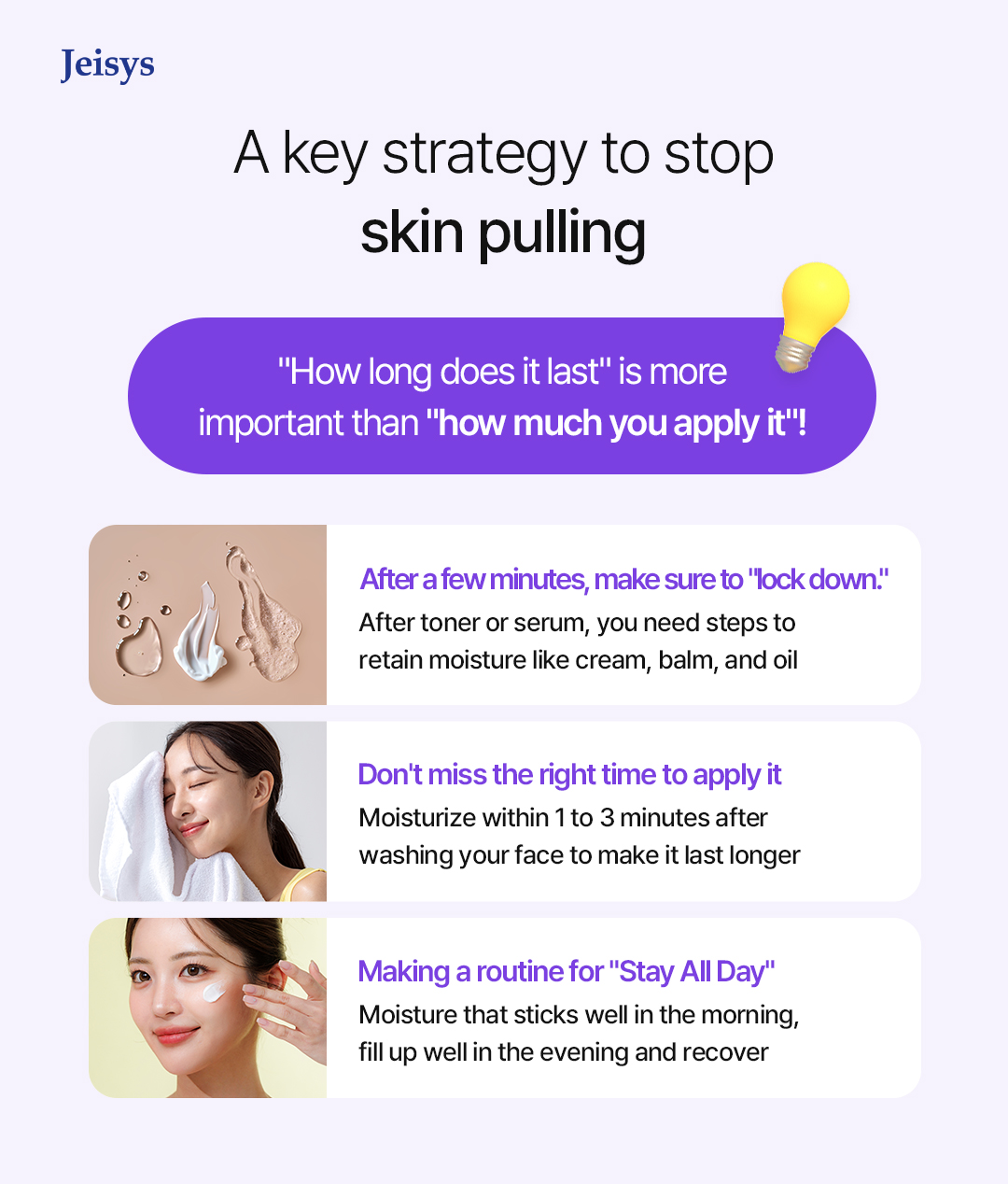
To prevent skin tightness, the direction of winter moisture management must change from ‘filling moisture’ to ‘holding moisture.’ Now, “how long it is maintained” is more important than “how much you apply.”
✔ Action Strategy 1. Always follow with a ‘Locking Step’
After filling with moisture toner or serum, a step to hold that moisture so it doesn't escape—like a cream, balm, or oil—is absolutely necessary. If you only apply moisture and stop there, evaporation actually speeds up, which can make skin dryness worse.
✔ Action Strategy 2. Don’t miss the application timing
The 1–3 minutes after washing your face is the time when the skin loses moisture the fastest. If you moisturize immediately during this time, the moisture maintenance power will be significantly different even with the same product.
✔ Action Strategy 3. Plan a routine from an ‘All-day maintenance’ perspective
It is also an effective method to create a routine: moisture management in the morning with light but high-adherence moisturizing, and moisturizing in the evening to sufficiently fill and secure recovery time.
By dividing strategies by time of day like this, you will be able to see a noticeable decrease in the tightness characteristic of dry skin. Please remember this one point!
Just because your skin kept pulling in winter didn't mean it was in an exceptionally moisture-deficient state. In most cases, it wasn't that you couldn't fill the moisture, but simply that you weren't able to protect the moisture you had filled.
From now on, rather than applying more moisturizer, why not try changing the direction of moisture management slightly toward creating an environment where moisture can stay? You will feel the moment when the tightness from skin dryness decreases and your skin becomes much more comfortable, faster than you think!
Remember! Winter skin care begins not with 'filling,' but with 'protecting.'

