
- Author
- Date
- 2025-12-09
- Views
- 474
Cold weather, frigid wind… In winter, our skin receives a shock that goes beyond simple dehydration, 'chilling down' from the inside. Changes like nasolabial folds suddenly appearing deeper or the cheeks and midface line looking flat are largely related to decreased skin temperature.
As experts point out that “climate change and environmental stress directly influence the speed of skin aging and its elastic structure,” seasonal changes create significant variables in the effectiveness of nasolabial fold management and midface lifting.
The reason why moisturizing with daily products isn't enough is rooted in a vicious cycle at the core: ‘Skin Temperature Change → Reduced Blood Flow → Collapse of the Elastic Structure.’
In this article, we will organize a ‘Skin Temperature-Focused’ management strategy to restore midface elasticity, nasolabial folds, and volume, which are easily weakened in winter.
Table of Contents
- Trend 1. The Actual Changes Caused by Dropping Winter Skin Temperature
- Trend 2. How Does Winter ‘Midface Elasticity Collapse’ Affect Your Impression?
- Trend 3. The ‘Skin Temperature Management Elasticity Routine’ for the Cheek and Nasolabial Line
Trend 1. The Actual Changes Caused by Dropping Winter Skin Temperature
In winter, the skin becomes sluggish, makeup doesn't adhere well, the area near the nasolabial folds becomes noticeably prominent, and the facial contour blurs. However, these phenomena cannot be explained simply by “it's dry because it's winter.” The reality is that the process of the skin's elastic structure weakening due to lowered skin temperature is often overlooked.
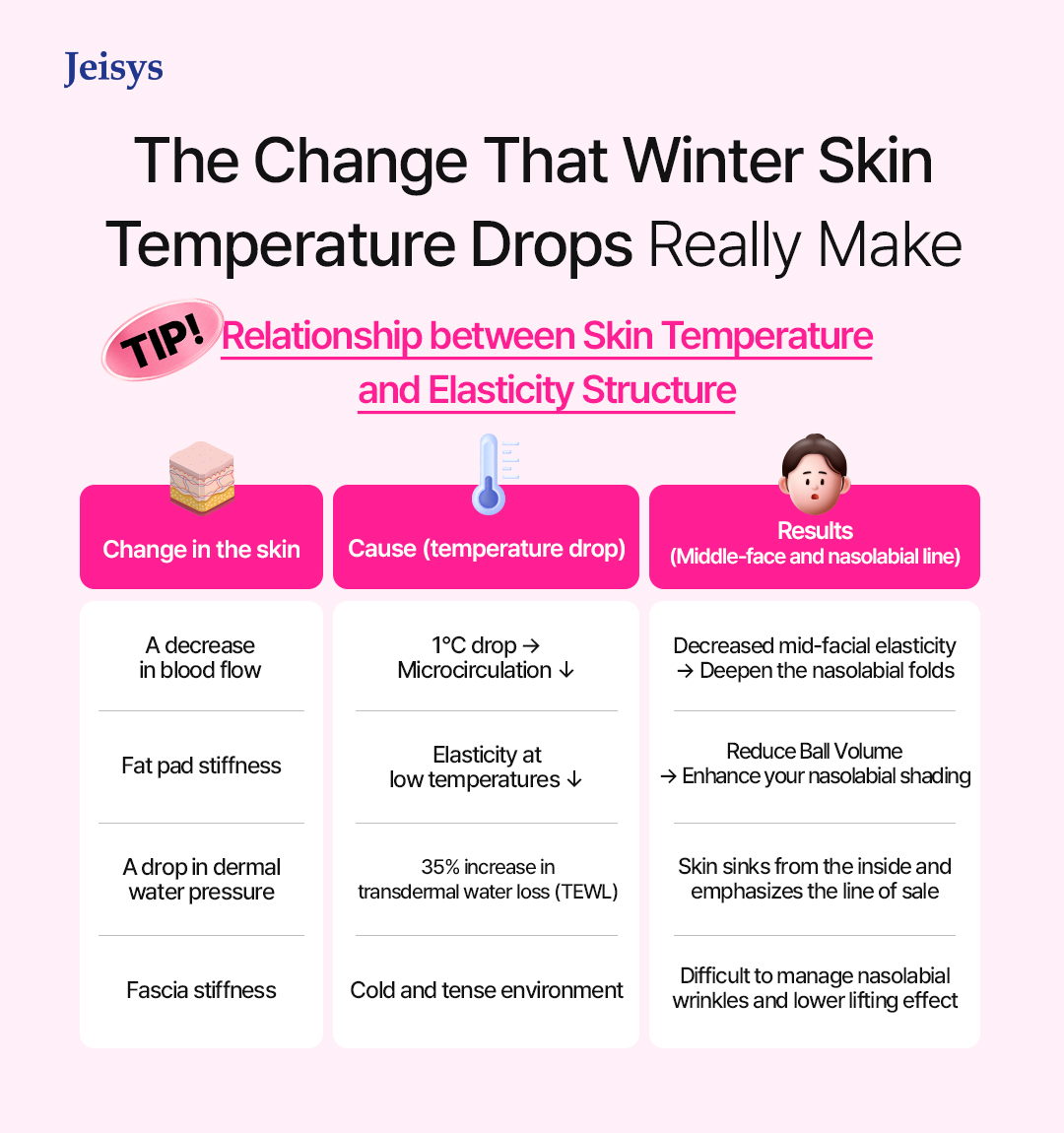
TIP! The Relationship Between Skin Temperature and Elastic Structure
| Skin Change | Cause (Temp. Drop) | Result (Midface & Nasolabial Line) |
|---|---|---|
| Blood Flow Reduction | 1°C Drop → Microcirculation↓ | Reduced Midface Elasticity → Deepening Nasolabial Folds |
| Fat Pad Rigidity | Reduced Elasticity at Low Temps↓ | Decreased Cheek Volume → Enhanced Nasolabial Shadowing |
| Dermis Water Pressure Drop | Trans-Epidermal Water Loss (TEWL) 35% Increase | Skin Sinks Internally, Highlighting Nasolabial Line |
| Fascia Rigidity | Cold, Tense Environment | Difficulty in Nasolabial Fold Management and Reduced Lifting Effect |
When the skin temperature drops in winter, the micro-blood flow inside the skin is the first to slow down. If the skin temperature drops by just 1°C, blood circulation decreases, midface elasticity quickly weakens, and as a result, nasolabial folds can appear deeper.
Furthermore, in a cold environment, the fat pads (fat cushions) that support the cheeks stiffen and lose elasticity, causing the cheek volume to look sunken more easily than usual. When the cheeks flatten like this, shadows naturally form in the nasolabial area, making the nasolabial shadowing appear darker and more pronounced.
In addition, winter causes Trans-Epidermal Water Loss (TEWL) to increase by about 35%, reducing the water pressure of the dermis. This process causes the skin to 'slump' from the inside, which is a cause of emphasizing the nasolabial line.
Above all, the stiffening of the fascia and facial muscles due to the cold is also a problem. When the body is cold, the face unconsciously tenses up, and if this state is repeated, nasolabial fold management becomes more difficult, and the lifting effect is also likely to diminish.
Trend 2. How Does Winter ‘Midface Elasticity Collapse’ Affect Your Impression?
In winter, people increasingly notice that their nasolabial folds are deep, their cheeks look hollow, and they appear much more tired and older in the afternoon than in the morning. This is not just due to aging, but because the cold and dry environment of ‘winter’ directly breaks down midface elasticity and the structural support of the face.
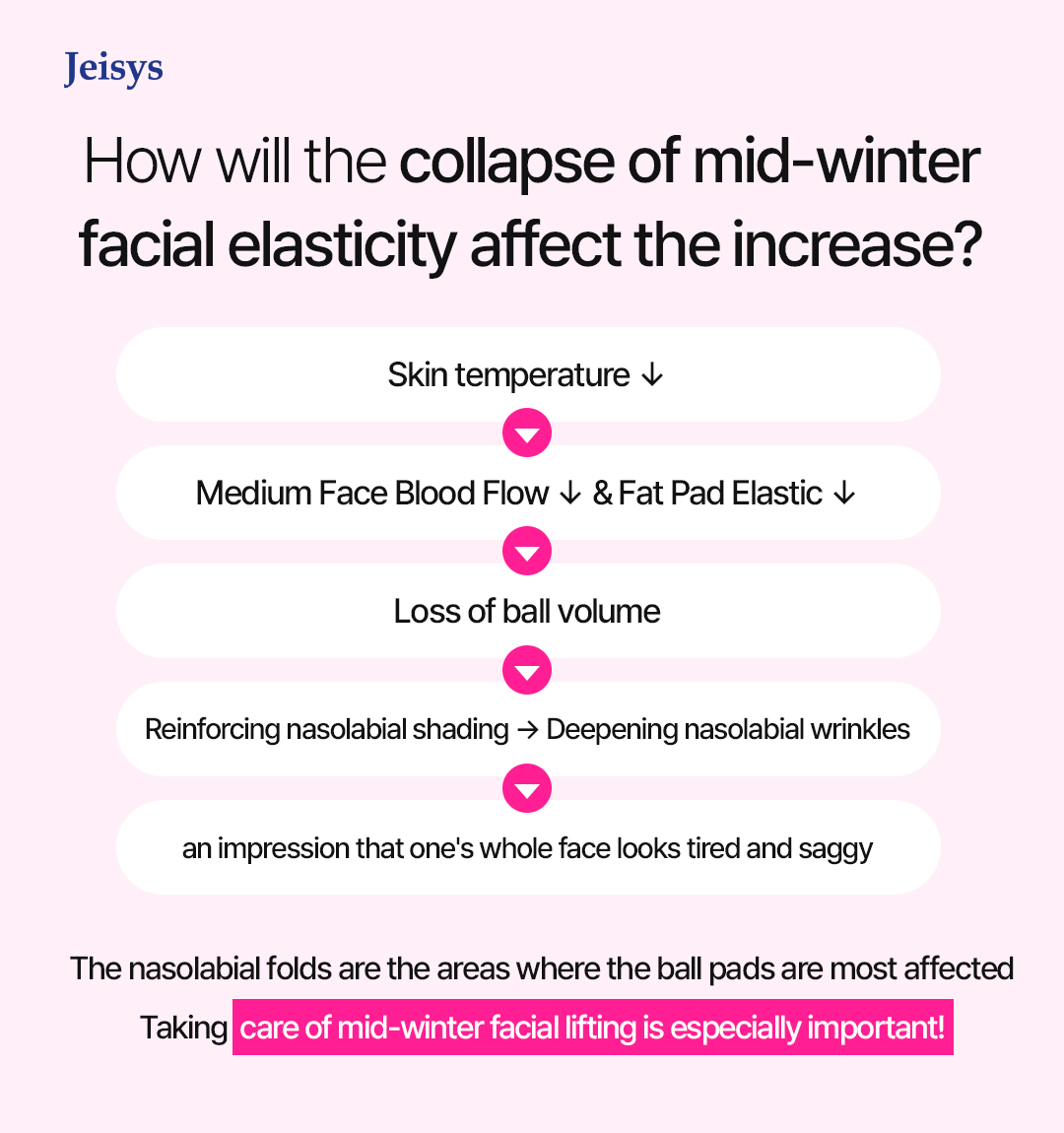
The collapse of midface elasticity is a direct factor leading to changes in your overall impression. Reviewing the overall flow below may make it easier to understand:
Skin Temp↓
↓
Midface Blood Flow↓ & Fat Pad Elasticity↓
↓
Loss of Cheek Volume
↓
Enhanced Nasolabial Shadowing → Deepening Nasolabial Folds
↓
Overall Tired and Saggy Impression
As skin temperature drops in winter, micro-blood flow in the midface (cheeks & nasolabial area) slows down, and the elasticity of the fat pads weakens. During this process, cheek volume gradually decreases, and as a result, shadowing deepens in the nasolabial area, making the nasolabial folds look deeper.
Ultimately, the overlap of these changes creates an overall impression that the entire face looks tired and droopy.
Crucially, the nasolabial fold (nasolabial line) area is the section most strongly affected by the sinking of the cheek pads, making winter midface lifting management particularly important.
Trend 3. The ‘Skin Temperature Management Elasticity Routine’ for the Cheek and Nasolabial Line
“Even the best firming ampoule has a weak effect in winter…” This concern is not about the product; it's because the absorption rate of ingredients and the speed of elasticity recovery itself decrease due to the low skin temperature.
Therefore, our routine for nasolabial fold management & midface lifting must prioritize ‘raising the skin temperature’ before focusing on ingredients!
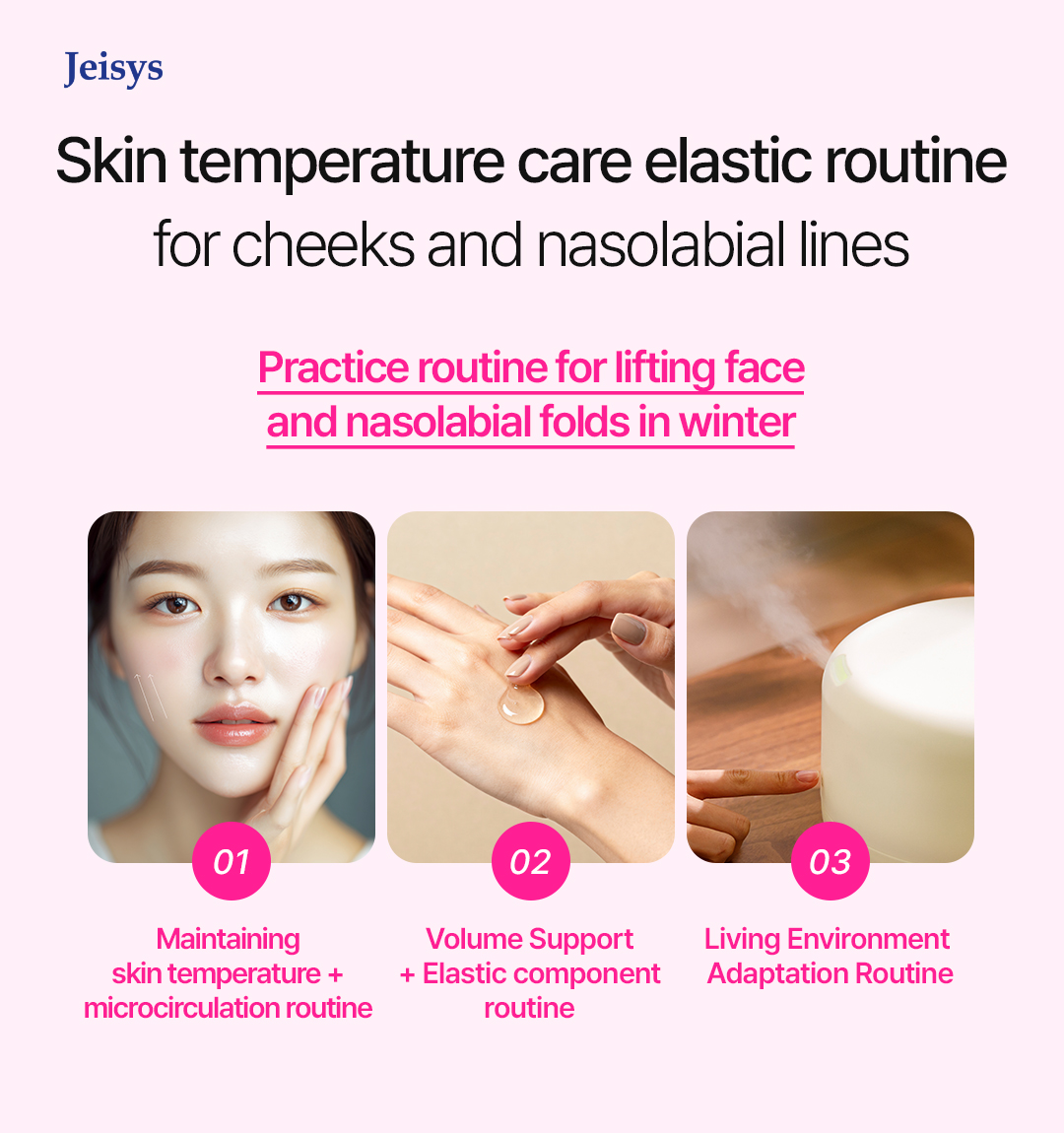
✔ Winter Midface Lifting & Nasolabial Fold Management Routine
① Skin Temperature Maintenance + Microcirculation Routine
- Quick moisturizing barrier within 10 seconds after cleansing
- 30 seconds of warm pressing with warm palms
- Use a warm pack or thermal device to maintain 38–42°C (the zone of highest elasticity activation)
② Volume Support + Elasticity Ingredient Routine
- Peptides: Strengthen dermal elastic network
- Low-molecular Hyaluronic Acid: Restore dermal water pressure → Midface Volume↑
- EGF/PN Regeneration Cream: Accelerate elastic regeneration
- Niacinamide: Relieve micro-inflammation → Nasolabial Shadow Relief
③ Environmental Adaptation Routine
- Maintain indoor humidity at 40–55%
- Avoid direct airflow from heating units
- Warm compress + moisturizer before sleep
- Standardize the night routine centered on winter skin temperature management
Thus, the collapse of the cheek & nasolabial line in winter is not merely due to dryness but stems from a clear circulatory structure: Skin Temperature Drop → Elastic Structure Collapse → Reduced Cheek/Nasolabial Volume → Deepening Nasolabial Folds.
Fortunately, if we pay a little more attention to skin temperature, midface elasticity quickly returns, nasolabial folds are pleasantly softened, and the entire face begins to look more lively and youthful.
How about adding the Skin Temperature Management + Midface Lifting + Nasolabial Fold Management routines to your daily life this winter?! Your face will truly regain the ‘power to hold up’ in a surprising way.

