
Moist Skin After Cleansing, Is It Truly Healthy Skin? - Why Dryness and Moisturizing Management are Essential -

“I switched my foam cleanser because I heard that non-tightening cleansers are good… but instead, my skin feels stuffier and breakouts seem to be appearing.” There are surprisingly many people expressing these difficulties lately.
In the past, people felt “squeaky clean” meant a good wash, but nowadays, “moist skin after cleansing” has become the standard for quality cleansing. Indeed, if the skin doesn’t feel tight and remains comfortable, it gives a sense of satisfaction, making you think you’ve found the right product.
However, the problem starts here. Even though the tightness has decreased, there are cases where the skin feels slippery, becomes oily quickly, skincare products feel like they are just sitting on the surface, and tiny bumps begin to repeat.
Naturally, this leads to confusion. “Isn’t it good if it doesn’t feel tight?” “It feels moist, but why does my skin feel so stuffy?” Actually, there is a point that many people are missing.
The absence of ‘tightness’ after cleansing does not necessarily mean a healthy skin condition. Skin is not just about removing oil; it functions through the coordination of all elements, including the skin barrier, oil-water balance, surface pH, the balance between sebum and moisture, and internal moisture retention.
Therefore, judging a good cleanser based solely on the feeling immediately after washing can be more difficult than you think.
Table of Contents
Trend 1. The Principle Behind Tightness After Cleansing
Trend 2. Is Non-Tightening Skin Always Good?
Trend 3. Skin Troubles Caused by Incorrect Cleansing
Trend 1. The Principle Behind Tightness After Cleansing
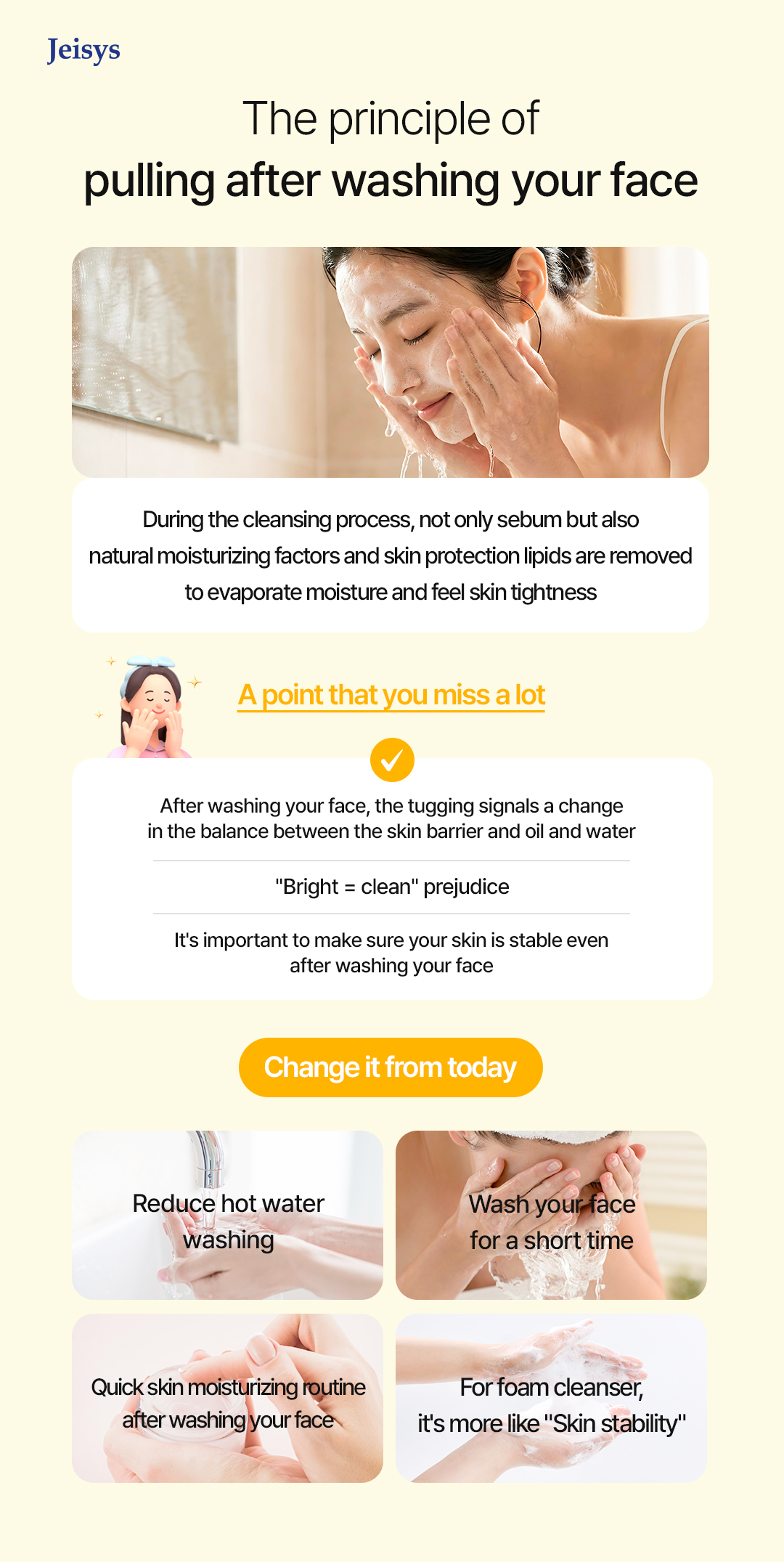
Many people think of tightness after cleansing as general skin dryness. However, in reality, much more complex changes are occurring on the skin surface.
When you wash your face, various changes occur, such as the removal of surface oils, increased moisture evaporation, changes in skin pH, temporary disruption of the skin barrier, and a decrease in lipids that acted as a protective shield. In other words, cleansing is not just a process of washing away waste; it is closer to a process that momentarily alters the skin environment itself.
Then, why does the skin feel ‘tight’? This is because not only the sebum on the surface but also the natural moisturizing factors and parts of the protective lipids are removed during the cleansing process. In this state, moisture inside the skin evaporates more easily than usual, and the skin surface temporarily tenses up, leading to what we commonly call “tightness.”
This feeling can be much stronger, especially when using a foam cleanser with high detergency. The issue is that many people mistake this ‘squeaky clean feeling’ for a good wash. Of course, you may feel refreshed when excessive sebum and waste are removed.
However, if the skin is excessively squeaky, it could be the result of causing skin dryness and skin barrier stress. In other words, many cases involve accepting the “dryness signal” from the skin as cleanliness. Ignoring these signals can hinder true **skin recovery**.
Furthermore, if strong cleansing is performed repeatedly, the skin may even increase sebum secretion to protect itself. Therefore, while it feels refreshed right after washing, an unstable cycle develops where it becomes oily faster over time.
---
✔ Points Often Missed
* Tightness after cleansing may not be simple dryness but a signal of changes in the skin barrier and oil-water balance.
* The prejudice that “Squeaky = Clean” can lead to excessive cleansing habits.
* It is more important whether the skin remains stable over time than the freshness immediately after washing.
✔ Try Changing from Today
* Reduce washing with hot water.
* Do not make the cleansing time excessively long.
* Quickly follow up with a moisturizing routine after cleansing.
* Choose a foam cleanser based on skin stability rather than “squeakiness.”
---
Trend 2. Is Non-Tightening Skin Always Good?
Recent cleansing trends are definitely changing. Rather than the strong detergency of the past, factors such as hypoallergenic, low acidity, skin barrier protection, a moist finish, and moisturizing-centered management are considered much more important.
In fact, cleansing that protects the skin barrier and reduces unnecessary irritation is very important. This is because, especially in the case of sensitive skin or severe dryness, the skin can easily become sensitized if strong cleansing is repeated.
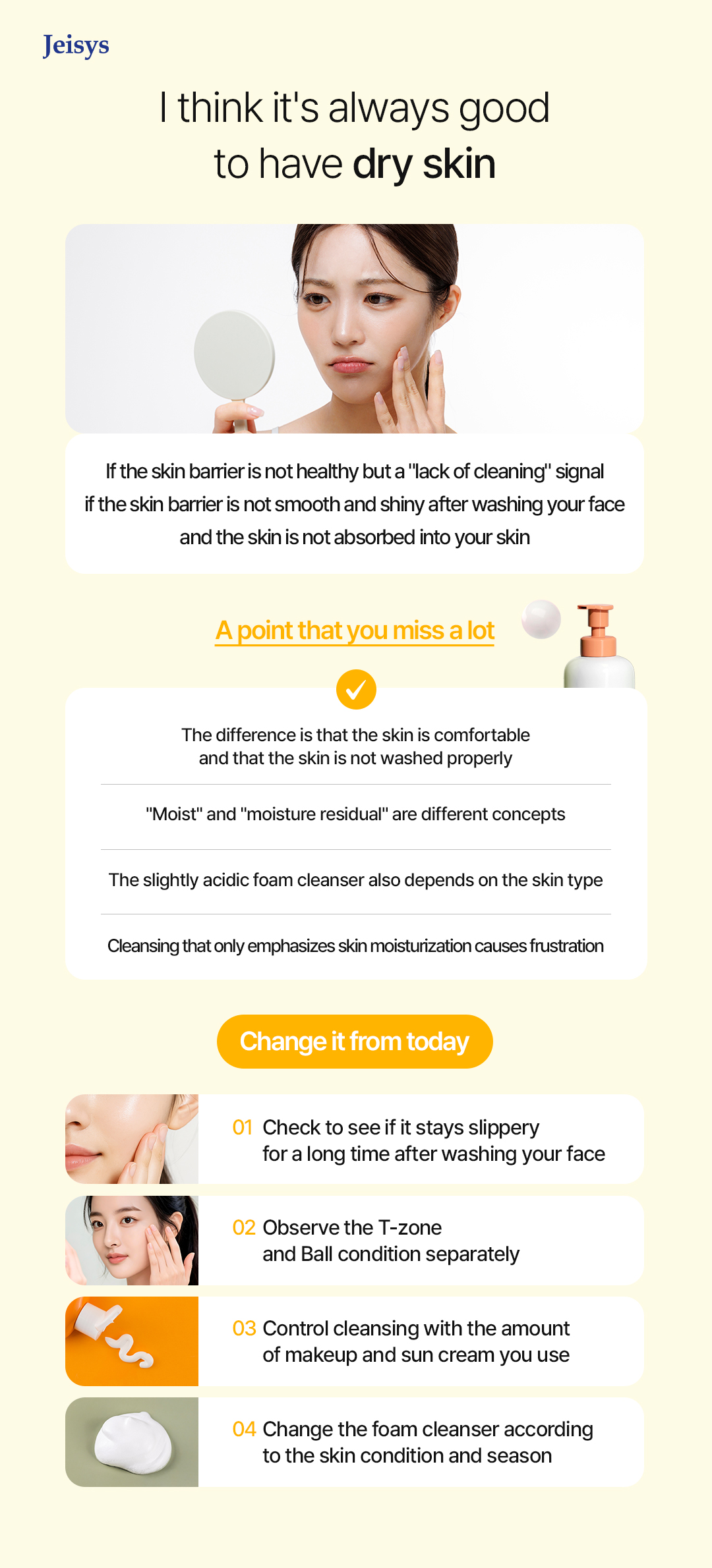
However, another misunderstanding begins to arise here: “If it feels moist after washing, it is definitely a good wash.” The problem is that a comfortable skin state is a completely different story from a state where oil or waste products have not been sufficiently removed.
For example, if a slippery feeling persists after washing, oiliness appears quickly, skincare products aren't absorbed well, and tiny bumps repeat, it might not be a healthy skin barrier but a signal of ‘insufficient cleansing.’
Recently, as “non-tightening cleansing” is overemphasized, there are increasing cases of insufficient detergency that does not suit the skin type.
If you insist on an excessively mild foam cleanser despite having oily skin, or if residues of makeup and sunscreen are not sufficiently removed, sebum and waste will remain in the pores, potentially leading to skin troubles. While the skin should be moist, that moisture should not be ‘residual oiliness.’
Another important point is that the skin condition varies by area. For instance, the T-zone may be oily while the cheeks are dry, meaning the balance can feel different even on the same face. Finding this balance is a core part of **skin recovery**.
Therefore, it is much more important to find a balance that suits your skin condition rather than simply pursuing “mild cleansing.”
---
✔ Points Often Missed
* A comfortable skin feeling is different from a proper wash.
* “Moistness” and “residual oiliness” are completely different concepts.
* Low-acid foam cleansers can feel different depending on the skin type.
* Cleansing that only emphasizes moisturizing can actually create a stuffy feeling.
✔ Try Changing from Today
* Check if a slippery feeling lingers for a long time when touching your skin after washing.
* Observe the condition of your T-zone and cheeks separately.
* Adjust the intensity of cleansing according to the amount of makeup and sunscreen used.
* Flexibly change your foam cleanser according to skin condition and season.
---
Trend 3. Skin Troubles Caused by Incorrect Cleansing
Looking at recent cleansing trends, it is notable that the standards are becoming increasingly extreme. In the past, it was “Squeaky means clean,” but now it has flipped 180 degrees to “Tightness is always bad.” However, skin cannot be simply divided into one or the other.
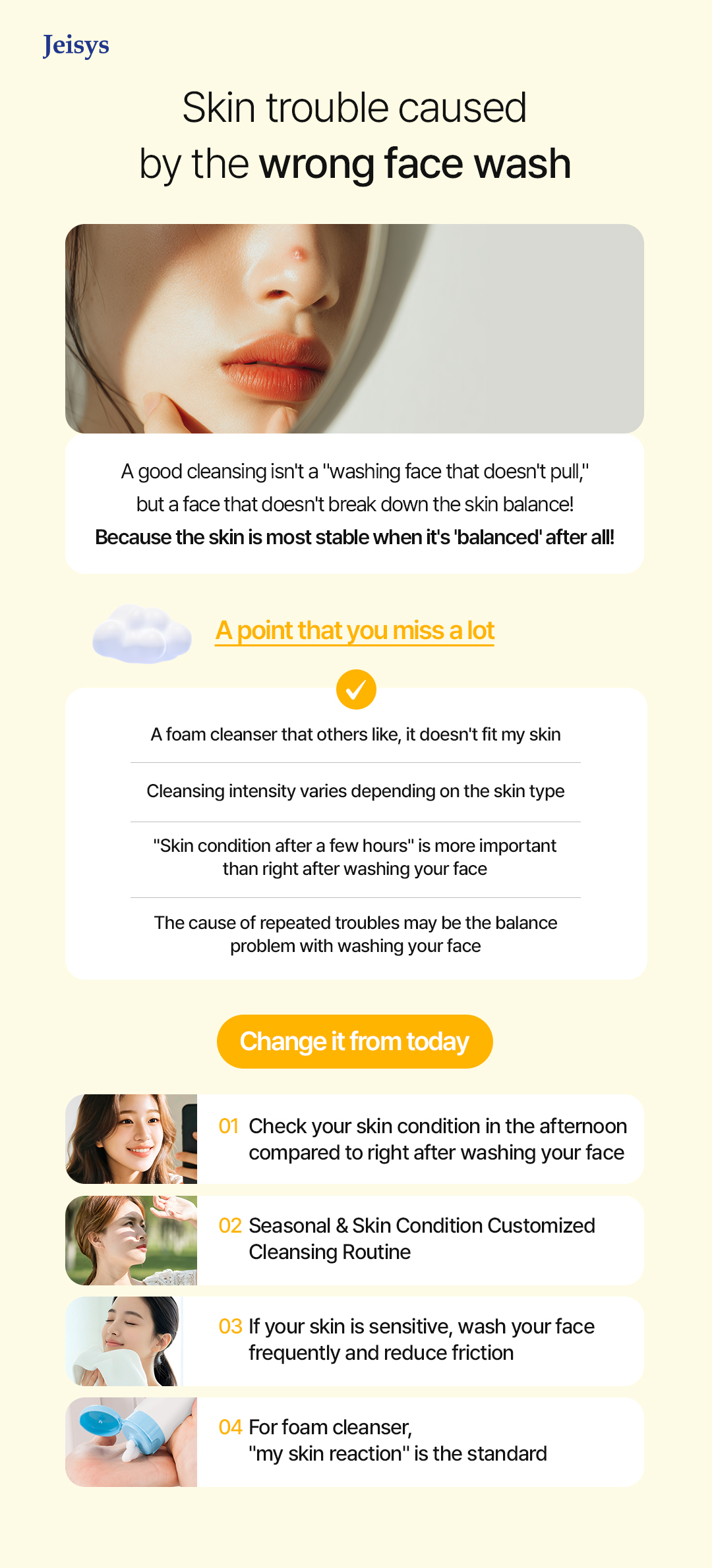
Excessive removal of oil is a problem, and conversely, leaving excessive oil can also cause issues. This is because skin is most stable when it maintains a ‘balance.’
For example, oily skin is prone to problems such as sebum accumulation, clogged pores, increased blackheads, and recurring skin troubles if the detergency is too weak.
On the other hand, for dry or sensitive skin, repeated excessive cleansing can lead to intensified dryness, skin barrier damage, increased moisture loss, skin tightness, and increased sensitivity. Also, the required cleansing balance can change depending on the season, sleep status, fatigue, skin condition, and hormonal changes for the same person.
For instance, in the summer, more detergency might be needed as sebum secretion increases, while in the winter, moisturizing and maintaining the protective shield become more important. Yet, many people keep a fixed product and cleansing method.
However, skin is much more fluid than you might think. Therefore, good cleansing is not just “non-tightening wash” but closer to a wash that does not disrupt the skin balance. In particular, recent skincare trends have begun to place more importance on how stably the skin is maintained after washing rather than “how strongly it is washed.” This is the true process of **skin recovery**.
---
✔ Here is the Point Often Missed
* A foam cleanser that others say is good may not be right for your skin.
* The required cleansing intensity can be completely different depending on the skin type.
* The “skin condition a few hours later” can be more important than right after washing.
* The cause of recurring troubles may be a cleansing balance issue.
✔ Try Changing from Today
* Check your skin condition in the afternoon rather than right after washing.
* Adjust your cleansing routine according to the season and skin condition.
* On days when the skin is sensitive, reduce the frequency and friction of washing.
* Choose a foam cleanser based on “your skin’s reaction” rather than “popular products.”
---
Cleansing is not just a process of emptying the skin. it is a process that must consider the skin barrier, oil-water balance, and even the environment where the skin can maintain its own balance.
Therefore, what matters is not just the feeling immediately after washing. It is more important how stable the skin remains and whether the skin balance is well-maintained as time passes.
Ultimately, good cleansing is neither a strictly squeaky wash nor a strictly moist wash. It is closer to the process of finding the balance that fits your skin condition.
If you've been thinking lately, "Why does my skin feel stuffy even though it doesn't feel tight?" it could be another balance signal from your skin.