
Why Are Blemishes and Dark Spots Getting Darker Despite Applying Sunscreen Well?
“I apply sunscreen diligently, so why are my blemishes and dark spots getting darker?” This is a question that those with blemish concerns genuinely ask very frequently at dermatology clinics.
You make sure to pack sunscreen before going out, wear a hat on days when the sunlight is strong, and are consistently taking care of your skin, but one day when you look in the mirror, the pigmentation on your cheekbones seems darker and your skin tone looks patchy. Especially when taking photos, it suddenly starts bothering you to the point where you think, “Was my blemish originally this dark?”
When that happens, you naturally come to think like this: “Was the amount of sunscreen insufficient?”, “Should I switch to a better product?”, “Do I need to receive laser treatment...” Of course, ultraviolet rays are a very important cause that induces blemishes and hyperpigmentation.
However, there is a fact that many people are missing. The cause of blemishes can be far more complex than you think. Recently, even in the field of dermatology, factors such as repeated daily irritation, skin friction, heat irritation, and inflammatory responses are being discussed together as backgrounds that worsen blemishes and hyperpigmentation.
In other words, it means that ‘weak irritation being repeated’ rather than ‘one strong irritation’ can make the skin stay dark for longer. And more irritation than you think is hidden inside the habits we repeat every single day.
Table of Contents
Trend 1. Are Ultraviolet Rays the Only Cause of Pigmentation
Trend 2. ‘Micro-Friction’ That Makes the Skin Turn Black
Trend 3. Daily Repeated Irritation Checklist
Trend 1. Are Ultraviolet Rays the Only Cause of Pigmentation
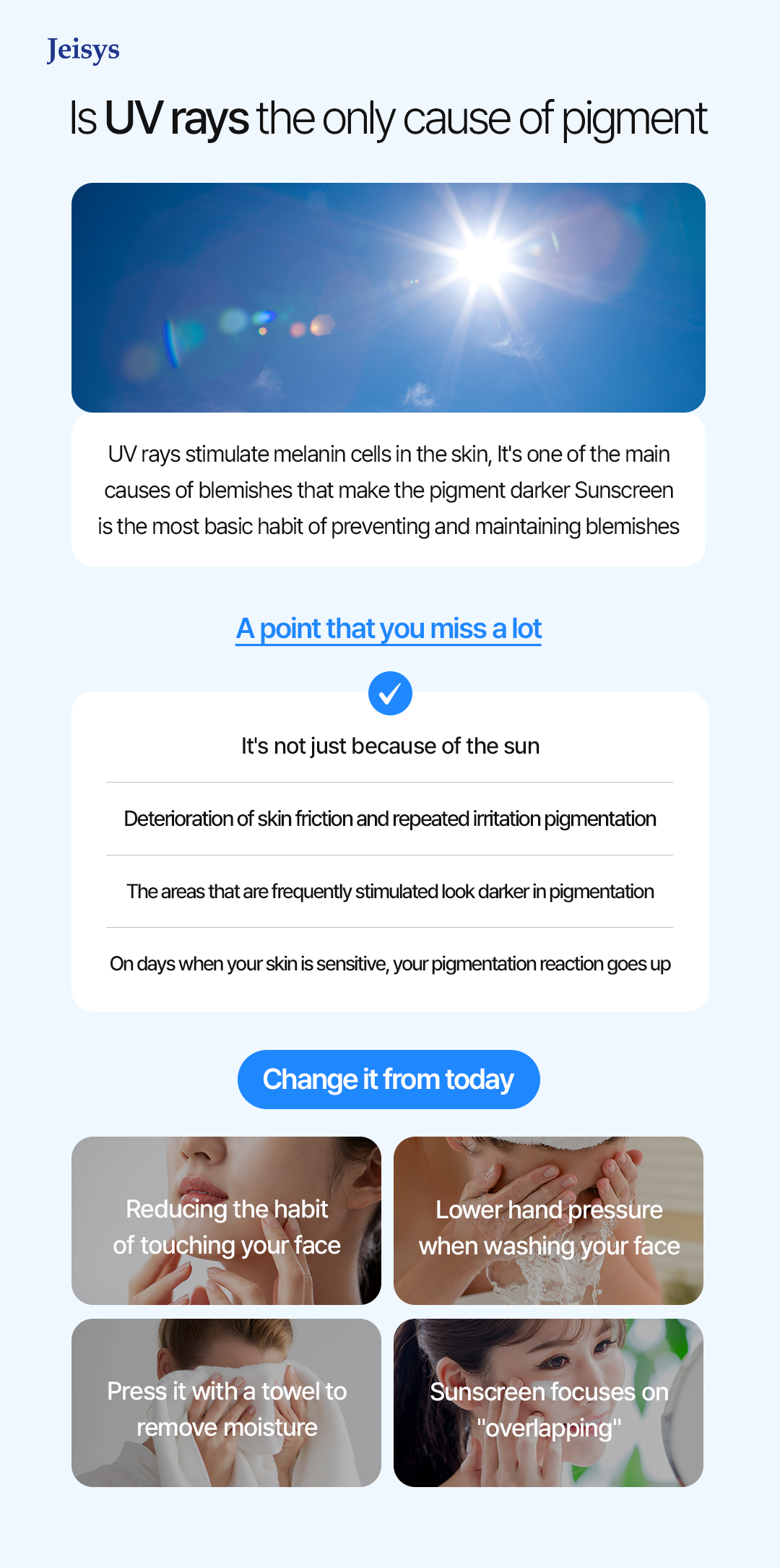
When talking about blemishes or hyperpigmentation, the first thing that comes to mind is, as expected, ultraviolet rays. In fact, ultraviolet (UV) light stimulates melanin cells inside the skin and is one of the representative blemish causes that make pigmentation darker. That is why applying sunscreen is regarded as the most foundational habit in blemish prevention and management.
Even so, some people say: “I really apply sunscreen diligently...”, “I even reapply it, so why does it get darker?” The reason may not be as simple as you think. This is because the cause of blemishes might not be a problem of ultraviolet rays alone.
Recently, there is a growing perspective that views blemishes and hyperpigmentation as a ‘multifactorial’ problem where multiple factors—such as ultraviolet rays, skin inflammation, heat irritation, skin friction in daily life, and skin barrier damage—act together.
✔ Points that are frequently missed, right here
· Blemishes are not simply due to sunlight alone
· Skin friction and repeated irritation can also worsen hyperpigmentation
· Areas that are frequently irritated, like the cheekbones, can look darker in pigmentation
· The more sensitive the skin is on a particular day, the larger the pigmentation response can be
✔ Try changing from today
· Reducing the habit of touching your face unconsciously
· Consciously lowering hand pressure when washing your face
· Removing moisture by patting gently rather than rubbing with a towel
· Focusing on “reapplying” sunscreen rather than applying “a lot at once”
---
Trend 2. ‘Micro-Friction’ That Makes the Skin Turn Black
When people think of skin irritation, many only recall strong irritations like intense peeling, lasers, or scrub products. However, the actual skin can react longer to a ‘situation where weak irritation is repeated every day’ rather than ‘one strong irritation’.
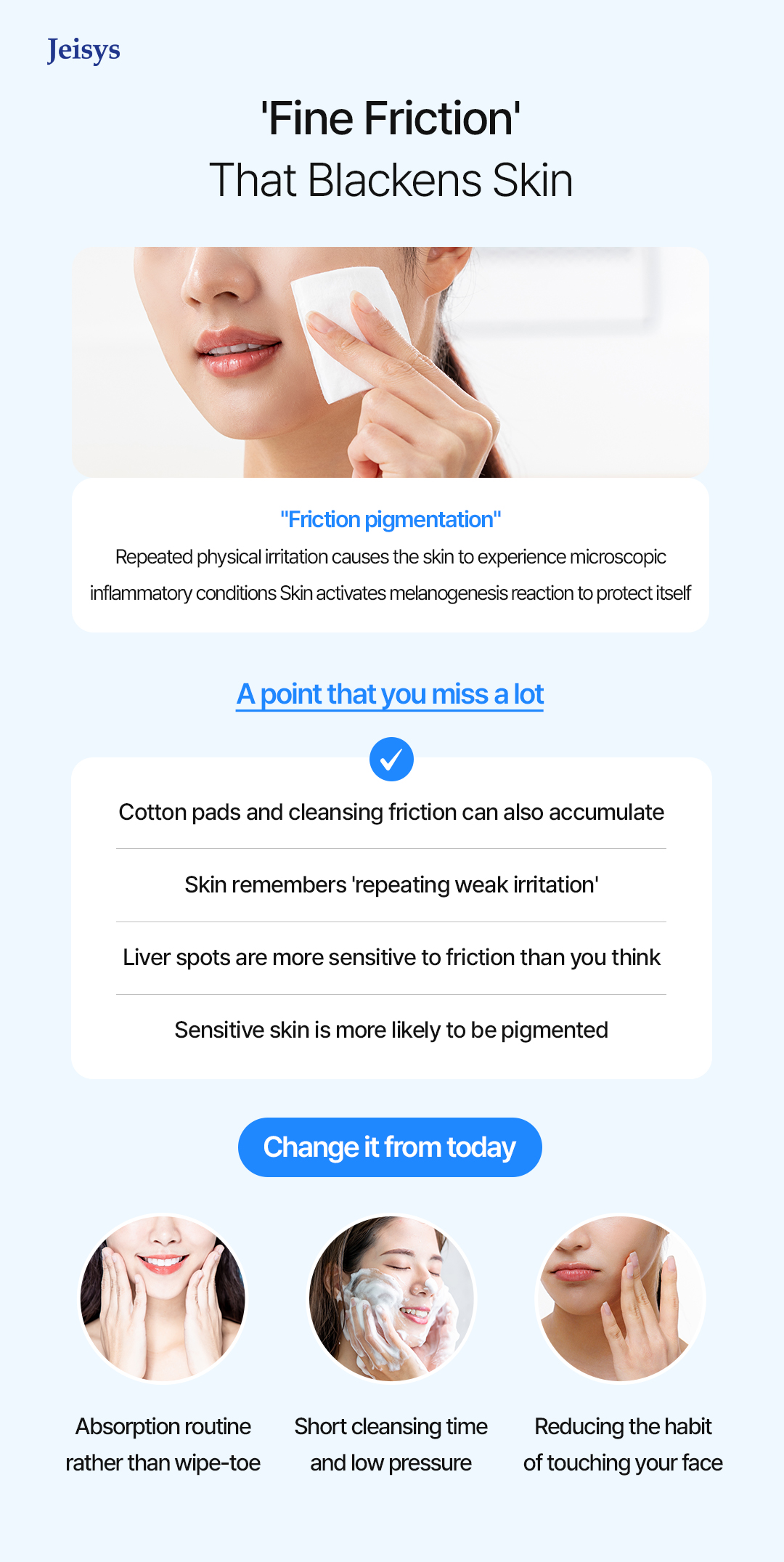
This part is the concept of ‘frictional hyperpigmentation’ that is being frequently discussed recently. When repeated physical irritation occurs, the skin experiences a micro-inflammatory state, and in this process, the skin can activate melanin production responses to protect itself.
Ultimately, as small irritations are repeated, the possibility of hyperpigmentation becoming darker arises. The problem is that there are truly many such irritations in our daily lives.
Especially for sensitive skin, similar impacts can manifest on a larger scale. This is because under a condition where the skin barrier is weak, irritation responses occur easily and the skin recovery speed slows down, which can increase the possibility of pigmentation remaining longer.
Therefore, for sensitive skin, a ‘less irritating routine’ rather than unconditionally strong functional products can be the start of blemish management.
✔ Points that are frequently missed, right here
· Friction from cotton pads and cleansing can also accumulate
· The skin remembers the ‘repetition of weak irritation’
· Blemish areas are more sensitive to friction than you think
· Sensitive skin can have a higher possibility of hyperpigmentation
✔ Try changing from today
· Increasing absorbing-type routines rather than wiping toner
· Shortening cleansing time and lowering pressure
· Consciously reducing the habit of touching your face
· Managing your skin so that skin heat does not persist for a long time
· Re-checking the frequency of exfoliating dead skin cells
---
Trend 3. Daily Repeated Irritation Checklist
There are far more cases where blemishes slowly become darker as daily irritations are repeated, rather than cases where they suddenly get dark. That is why checking daily habits is as important as treatment.
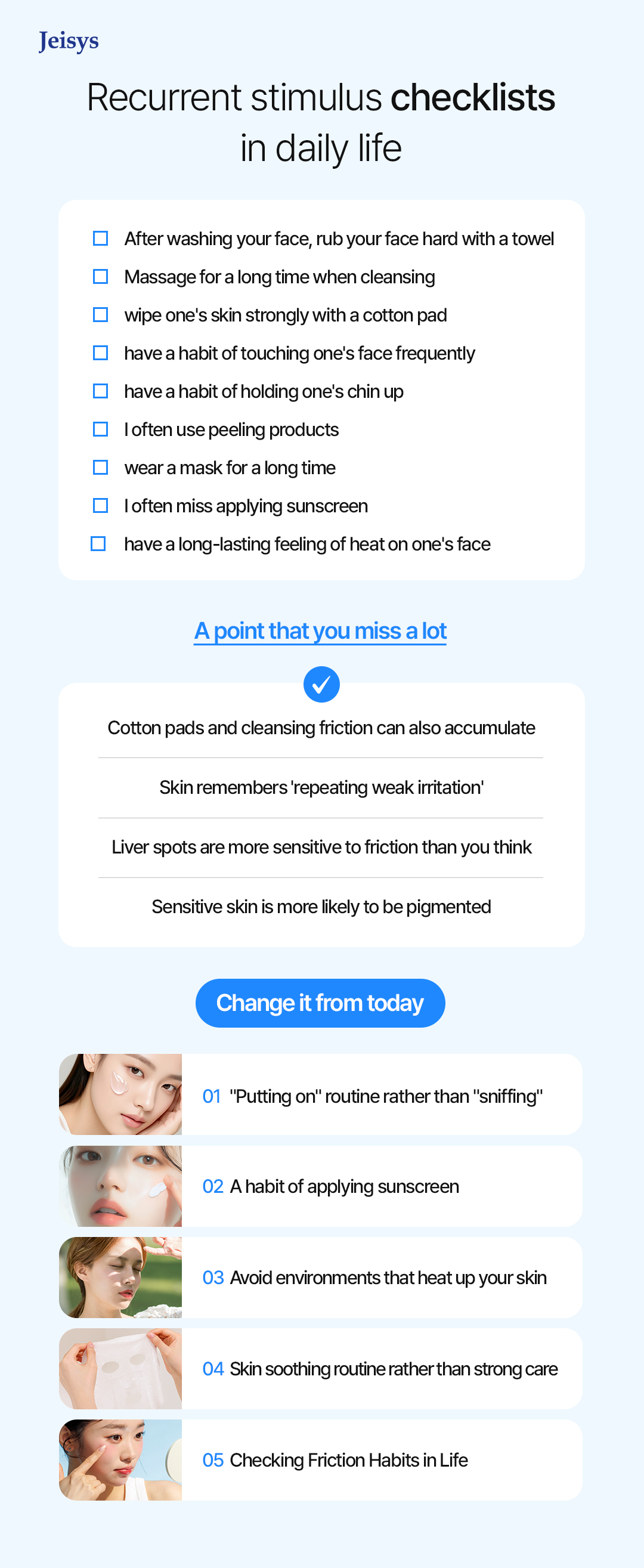
* Daily Repeated Irritation, Self-Examination!
□ Rubbing the face hard with a towel after washing
□ Massaging for a long time during cleansing
□ Wiping the skin strongly with a cotton pad
□ Having a habit of frequently touching the face
□ Having a habit of resting the chin on the hand
□ Frequently using peeling products
□ Having a long mask-wearing time
□ Frequently missing the reapplication of sunscreen
□ Having skin heat persist for a long time
The behaviors in the checklist above look trivial when viewed one by one. However, the fact that they are ‘repeated every day’ can be the problem. This is because blemishes and hyperpigmentation frequently get darker gradually as small irritations accumulate.
That is why the direction of recent blemish management is also changing. If in the past it centered around “treatment after it occurs,” recently, “prevention-centered blemish management to keep it from turning darker” is becoming more important.
In other words, small habits themselves—such as blocking ultraviolet rays, reducing skin friction, skin soothing-centered routines, protecting the sensitive skin barrier, and managing skin heat—are becoming the core of pigmentation management.
✔ Points that are frequently missed, right here
· Blemishes are a pigmentary disorder with strong recurrence
· The impact of daily habits is as large as treatment
· Small skin friction can also make hyperpigmentation darker if repeated
· Skin heat can likewise stimulate pigmentation
✔ Try changing from today
· Creating an “overlaying” routine rather than “rubbing”
· Making the reapplication of sunscreen a habit
· Avoiding environments where the skin gets hot for a long time
· Increasing skin soothing routines rather than strong management
· Checking friction habits in daily life first
---
If your blemishes are getting darker despite applying sunscreen well, the reason might not be due to ultraviolet rays alone. The skin remembers even smaller irritations than we think. And as that irritation is repeated every day, the pigmentation can become slightly darker little by little.
Therefore, blemish management nowadays is changing into a direction that looks together not only at “how well you apply it” but also at “how less you irritate it.” Especially for areas with lots of repeated irritation like cheekbone blemishes, it is important to check daily habits together.
If you are recently having the thought, “I apply sunscreen diligently, so why are my blemishes getting darker?”, that might be a ‘daily irritation signal’ that your skin is sending.