
The Reason Your Face Feels Puffy and Swollen It is not just a matter of facial fat
“My weight is the same, so why does my face look bigger?”, “I definitely haven't gained weight, but my face looks duller in photos.” Have you ever had these thoughts at least once?
Compared to before, your body weight hasn't changed much, but from a certain point, your face starts to look wider, the jawline becomes blurred, and the overall facial line feels spread out. Especially when taking photos, there are moments when you think, “Was my face originally this wide?” Most people naturally end up thinking like this.
“Did I gain weight…”, “Is it because of facial swelling…” However, in reality, there are factors that have a greater impact than ordinary weight gain. These are the decrease in skin elasticity, facial swelling and edema, muscle tension, and changes in skin structure.
As these changes overlap, the face begins to look wider and duller than it actually is. In other words, your face hasn't actually grown larger; it may be in a state where it appears spread out as the 'boundaries of the contours' become blurred.
Table of Contents
Trend 1. Structural Reasons Why the Face Looks Wide
Trend 2. Differences Between Decreased Elasticity vs. Edema vs. Muscle Tension
Trend 3. The Process of Blurred Contours
Trend 1. Structural Reasons Why the Face Looks Wide
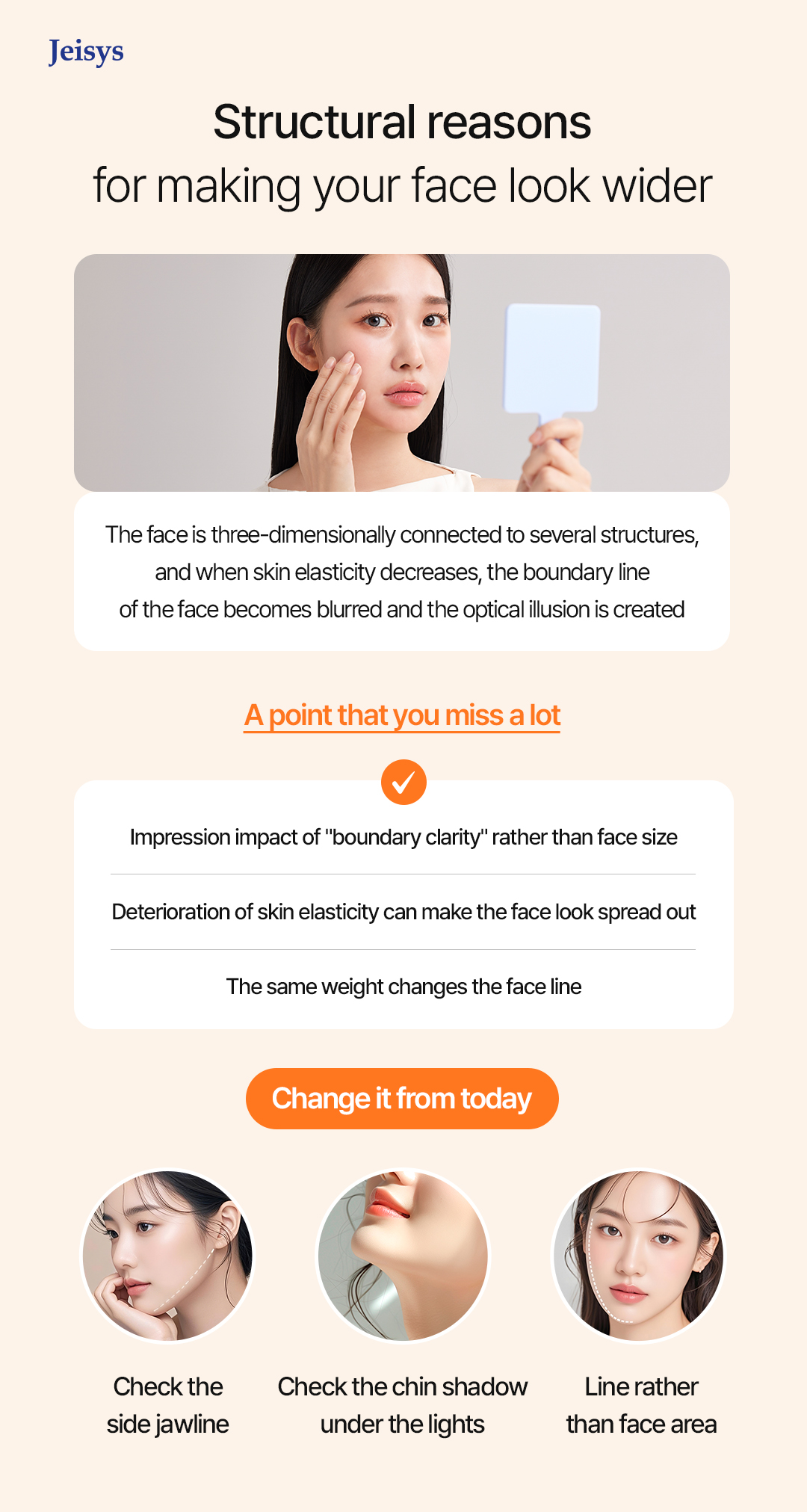
When the face looks big, many people think of “facial fat” first. However, what actually determines the impression of the face is not just the amount of fat. What matters are the ‘three-dimensional effect’ and the ‘facial line’ of the face.
The face is not a flat surface but a form where several structures are connected three-dimensionally. When boundaries such as the jawline, cheekbone line, mid-face volume, and lower face contour are clearly defined, the face looks smaller and sharper.
Conversely, when skin elasticity decreases and the boundaries of facial contours begin to blur, the jawline collapses, the cheek lines sag downward, and the facial area feels wider.
The important point here is that the face hasn't actually increased in size; rather, an 'optical illusion of appearing spread out' is created as the boundaries of the face become blurred.
For example, even at the same weight, a face with a sharp jawline looks small and clear, while a face with blurred facial lines can look wider and heavier.
Therefore, recently, contour management that maintains clear facial lines and contours is considered a more important management point than just a “small face.”
---
✔ The Point Often Missed
· “Boundary sharpness” has a greater impact on impression than facial size.
· The face can look spread out just due to decreased skin elasticity.
· Even at the same weight, the impression can vary greatly depending on the state of the facial lines.
✔ Try Changing from Today
· Check your side jawline rather than the front.
· Check the changes in the shadow of your jaw under the light.
· Start looking at the “facial line” before the “facial area.”
---
Trend 2. Differences Between Decreased Elasticity vs. Edema vs. Muscle Tension
Even with the same concern of “the face looking big,” the actual cause can differ for each person. Therefore, it is important to first understand which type of spread your face is experiencing.
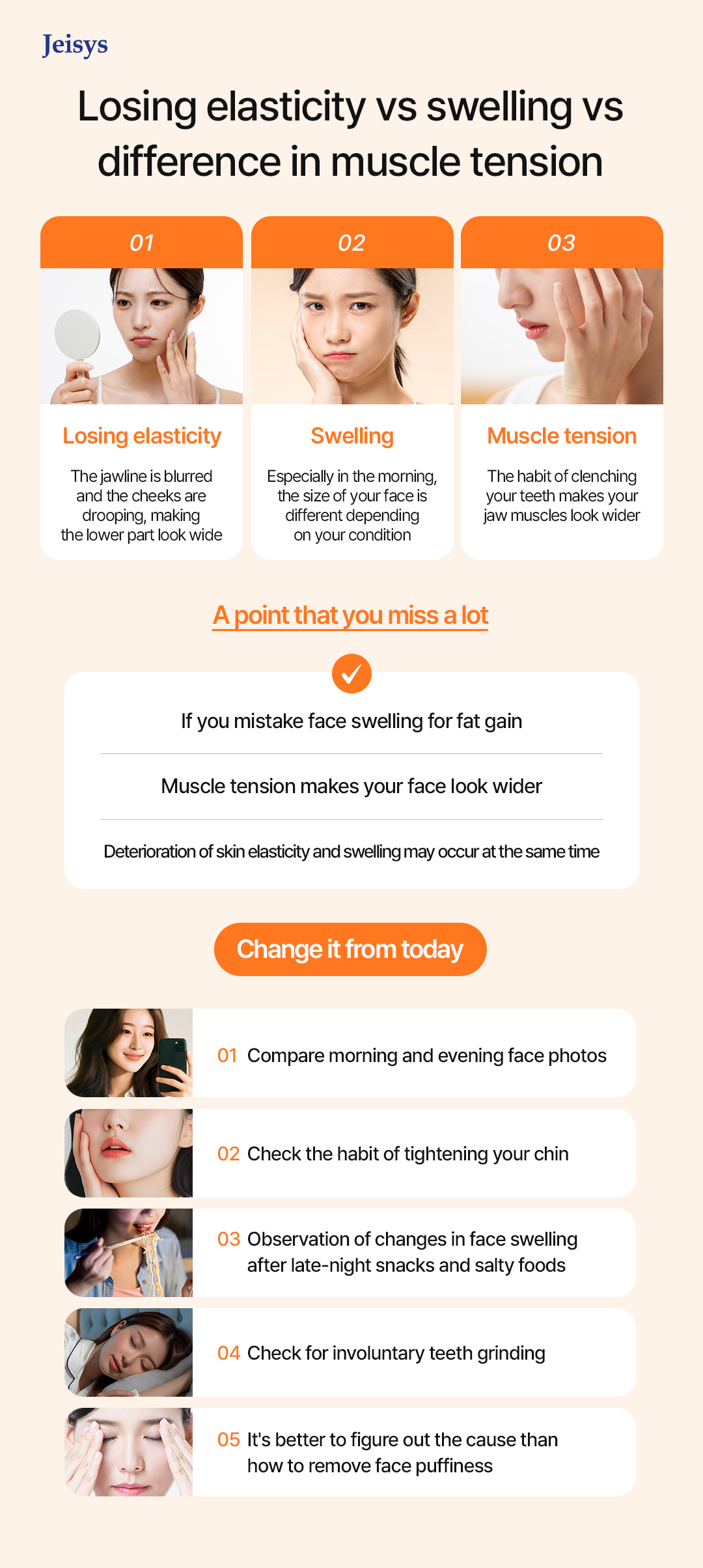
1) Decreased Elasticity Type
The decreased elasticity type is one of the most common types WHERE the jawline blurs, cheeks sag downward, and the lower part of the face feels wider. Especially as skin elasticity drops, the facial boundaries themselves begin to collapse. The characteristic of this type is that the face looks wide all day long. Unlike simple facial swelling, it often maintains a similar feeling regardless of your condition.
2) Edema Type
This is the type where the face swells particularly in the morning or the facial size looks different depending on your condition. Facial edema can easily worsen the day after eating late-night snacks, in a state of sleep deprivation, or after consuming salty foods, making the facial lines look spread out. Above all, facial swelling blurs the boundaries of facial contours, creating an impression that the face is much wider than it actually is. This is why many people look for ways to reduce facial swelling.
3) Muscle Tension Type
This is a type that many people surprisingly miss. If habits such as clenching the jaw, teeth grinding, or unconscious clenching are repeated, the jaw muscles develop, making the facial width appear wider. Especially if the lower face looks solid and heavy, it is necessary to suspect the influence of muscle tension. In other words, for the same facial concern, one person may have a skin elasticity problem, another an edema problem, and another a muscle tension problem.
---
✔ The Point Often Missed
· Facial swelling is often mistaken for an increase in fat.
· Muscle tension can make the facial width itself look wider.
· Decreased skin elasticity and facial edema often occur simultaneously.
✔ Try Changing from Today
· Compare photos of your face from the morning and evening.
· Check if you have a habit of putting pressure on your jaw.
· Observe changes in facial swelling after late-night snacks or salty food.
· Check for unconscious teeth grinding.
· Identifying the cause comes before unconditional methods to reduce facial swelling.
---
Trend 3. The Process of Blurred Contours
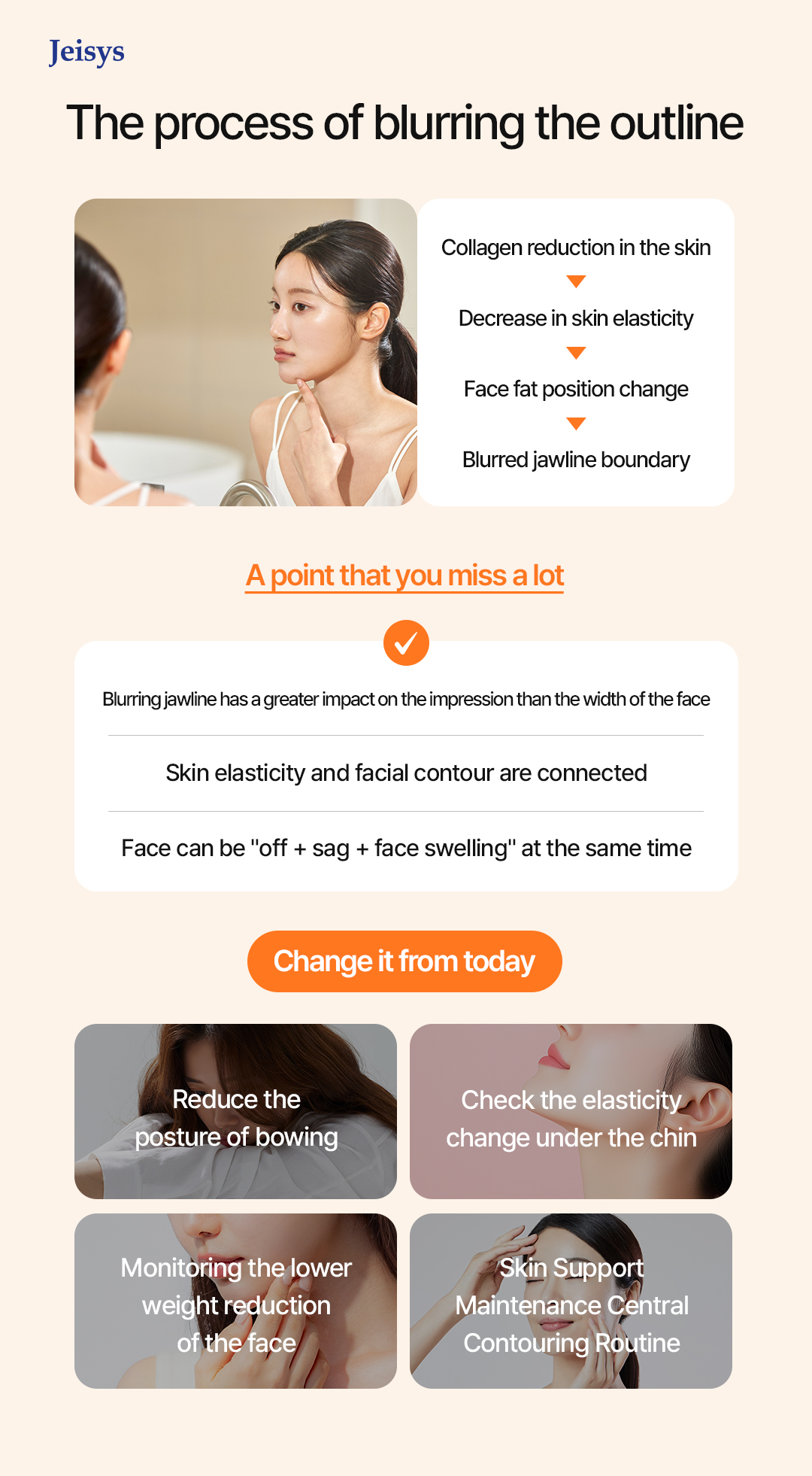
When talking about aging, many people only think of facial wrinkles first. However, in reality, the blurring of facial contours is often felt earlier. And at the starting point, there is a change in the power that supports the skin.
As time passes, collagen in the skin decreases and skin elasticity begins to drop, weakening the power that supports the facial structure. When changes in fat location are added to this, the facial impression begins to change little by little.
Volume that was previously at the top gradually moves downward, making the mid-face look hollow, the lower face look heavy, and the jawline boundaries look blurred. Especially when the boundary under the jaw blurs, the face appears much wider and duller than it actually is.
In other words, the face does not simply “grow larger,” but undergoes a “process where contours and facial lines blur.” Therefore, recent anti-aging trends are also changing.
If the focus was previously on “making a small face,” interest has recently shifted toward an approach centered on contour management, such as maintaining clear facial lines, natural three-dimensional effects, and a sharp jawline.
---
✔ The Point Often Missed
· A blurred jawline has a greater impact on the impression than facial width.
· Skin elasticity and facial contours are connected.
· Faces often undergo “hollowness + sagging + facial edema” simultaneously.
✔ Try Changing from Today
· Reduce postures with your head tilted down.
· Check for changes in elasticity under the jaw.
· Observe changes in the weight of the lower part of the face.
· Create a contour management routine centered on maintaining skin support.
---
When our face looks wide, we first think of weight gain. However, in reality, factors such as decreased skin elasticity, facial swelling and edema, muscle tension, and changes in facial structure act together to blur facial contours and make the face look wider and duller.
Therefore, the important thing is not just to reduce the size of the face. How clearly you maintain the boundaries of the facial lines can be a much more important point.
If you have been feeling lately that “I haven't gained weight, but my face looks big,” it may not be a simple weight problem, but a signal from changes in facial structure and contours.